The Exact Answer to How Many Ounces in a Quart – A Definitive Breakdown

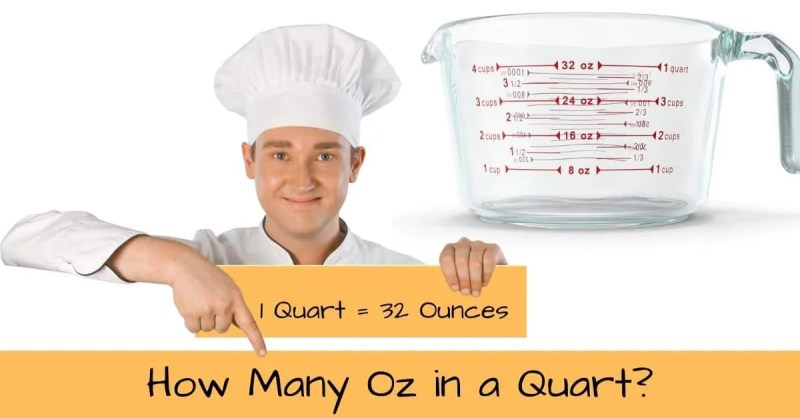
The quart has been the silent architect of countless recipes, scientific experiments, and everyday measurements—yet its relationship with ounces remains a source of confusion for many. At its core, the question "how many ounces in a quart" isn’t just about arithmetic; it’s a gateway to understanding an entire system of weights and volumes that have shaped trade, science, and domestic life for centuries. The answer, 32 fluid ounces, may seem straightforward, but the path to this number reveals layers of imperial logic, cross-cultural adaptations, and practical inconsistencies that persist even today.
What happens when you misapply this conversion? A baker substituting dry ounces for fluid ounces could ruin a cake. A chemist measuring reagents in milliliters might face catastrophic errors if they assume a quart’s equivalence without context. The stakes are higher than most realize. Even now, in an era of metric precision, the quart endures as a stubborn relic of tradition—one that demands respect for its nuances. Whether you’re scaling a recipe, calibrating equipment, or simply satisfying curiosity, mastering this conversion isn’t optional; it’s essential.
The confusion often stems from a fundamental misunderstanding: the quart isn’t a universal constant. In the United States, a liquid quart equals exactly 32 fluid ounces, while a dry quart (used for grains, fruits, or bulk goods) measures 37.23699 ounces—a discrepancy that can derail projects if ignored. Meanwhile, the imperial quart (used in the UK before metrication) aligns with the US liquid quart, but its practical applications differ. These variations aren’t just technicalities; they reflect deeper historical and cultural divides in how societies quantify the world.
The Complete Overview of "How Many Ounces in a Quart"
The conversion "how many ounces in a quart" is the cornerstone of fluid measurement in the US customary and imperial systems, yet its application extends far beyond simple arithmetic. At its simplest, the answer is 32 fluid ounces for a liquid quart, but the story behind this number—and its exceptions—unfolds across centuries of trade, imperial decrees, and scientific standardization. What makes this conversion particularly tricky is the coexistence of liquid and dry quarts, each serving distinct purposes in cooking, industry, and commerce. Ignoring these distinctions can lead to errors that range from mildly inconvenient to disastrous.Beyond the numerical answer lies a system designed for practicality, not perfection. The quart’s origins trace back to the Roman quadrans (a quarter of a sextarius), but its modern form was refined during the British Empire’s dominance, where it became a unit of trade for liquids like ale and wine. When the United States adopted its own system post-Revolution, it retained the quart but adapted it to local needs—hence the bifurcation into liquid and dry measurements. This duality ensures that a quart of milk and a quart of rice, though numerically close, aren’t interchangeable, a fact that confounds even seasoned professionals.
Historical Background and Evolution
The quart’s journey begins in medieval Europe, where volume measurements were tied to agricultural and commercial needs. The term itself derives from the Latin quartus, meaning "a quarter," reflecting its role as a subdivision of larger units like the gallon (originally four quarts). By the 14th century, English brewers and merchants standardized the wine quart and ale quart, though their sizes fluctuated based on regional preferences. This inconsistency persisted until 1824, when the UK formally defined the imperial quart as exactly 1.1365 liters—a decision that would later influence the US system.The American Revolution introduced a critical divergence. While the US inherited the imperial quart for liquids, it developed its own dry quart to accommodate bulk goods like grains and produce. This split wasn’t arbitrary; it reflected the young nation’s need for self-sufficiency in agriculture. The 1836 Weights and Measures Act in the UK and the 1866 US Metric Act (which codified customary units) further cemented these distinctions. Today, the liquid quart remains the standard for beverages, pharmaceuticals, and most household measurements, while the dry quart lingers in niche industries like baking and grain storage.
Core Mechanisms: How It Works
The conversion "how many ounces in a quart" operates on a hierarchical structure where each unit is a fraction or multiple of another. A US liquid quart is defined as 32 fluid ounces, with each ounce further divided into 8 dram equivalents (though drams are rarely used in modern contexts). This decimal-like progression—quart → pint → cup → fluid ounce—was designed for ease of mental calculation, a legacy of pre-industrial trade where merchants needed to estimate quantities quickly.Table of Contents
- The Complete Overview of "How Many Ounces in a Quart"
- Historical Background and Evolution
- Core Mechanisms: How It Works
- Key Benefits and Crucial Impact
- Major Advantages
- Comparative Analysis
- Future Trends and Innovations
- Conclusion
- Comprehensive FAQs
- Q: Why does a dry quart have more ounces than a liquid quart?
- Q: Can I use a liquid quart measurement for dry ingredients in a recipe?
- Q: Is the imperial quart the same as the US liquid quart?
- Q: How do I convert quarts to liters for international recipes?
- Q: Why do some old recipes use "wine quarts" or "ale quarts"?
- Q: Are there any countries still using quarts today?
- Q: How can I avoid mistakes when measuring quarts?
- Q: What’s the difference between a quart and a gallon?
- Q: Can I convert quarts to cubic inches?
- Q: Why does the US still use quarts if the metric system is more precise?
The dry quart, however, introduces a wrinkle. While it also equals 37.23699 ounces, this figure is derived from the US dry gallon (268.8025 cubic inches), not the liquid gallon (231 cubic inches). The discrepancy arises because dry goods pack differently than liquids, requiring a larger volume to achieve the same weight. This is why a quart of flour weighs more than a quart of water—a principle critical for bakers and chemists who must account for density variations.
Key Benefits and Crucial Impact
Understanding "how many ounces in a quart" transcends mere academic interest; it’s a practical necessity with real-world consequences. In cooking, for example, substituting fluid ounces for dry ounces in a recipe can alter texture and yield. A chemist measuring reagents might rely on quart-based dilutions, where precision is non-negotiable. Even in everyday tasks—like filling a cooler or dosing medication—the correct conversion ensures accuracy. The impact isn’t limited to professionals; homebrewers, gardeners, and DIY enthusiasts all depend on these measurements to achieve consistent results.The persistence of the quart system, despite global metric adoption, underscores its cultural and economic significance. In the US, where customary units remain deeply embedded in daily life, the quart serves as a bridge between tradition and modernity. It’s a unit that balances simplicity with flexibility, allowing for quick estimates in informal settings while accommodating scientific rigor in controlled environments. This duality ensures its relevance across disciplines, from culinary arts to industrial manufacturing.
"Measurements are the silent language of precision. A quart misread is a quart misapplied—and in some cases, the difference between success and failure." — Dr. Elias Whitmore, Historian of Metrology
Major Advantages
- Universal Compatibility: The 32-fluid-ounce quart aligns with the imperial system, ensuring consistency in trade, recipes, and scientific literature that predates metrication.
- Practical Scalability: The quart’s subdivisions (pints, cups) allow for intuitive halving and doubling, making it ideal for household and commercial use.
- Density Adaptability: The separate dry quart accommodates materials like grains and powders, where volume-to-weight ratios differ from liquids.
- Cultural Continuity: Retaining customary units preserves culinary and historical traditions, from heirloom recipes to industrial standards.
- Error Reduction: Clear distinctions between liquid and dry measurements minimize cross-contamination risks in fields like pharmacy and food safety.

Comparative Analysis
| Measurement System | Ounces in a Quart (Liquid) | Ounces in a Quart (Dry) | Key Use Cases |
|---|---|---|---|
| US Customary | 32 fluid ounces | 37.23699 ounces | Beverages, cooking, pharmaceuticals |
| Imperial (UK) | 32 fluid ounces (identical to US) | N/A (dry quarts phased out post-metrication) | Historical trade, legacy recipes |
| Metric (International) | ~29.5735 fluid ounces (1.1365 liters) | N/A (volume-based, not weight) | Global science, industry, trade |
| Apothecaries' System (Historical) | 30 fluid ounces (pre-19th century) | N/A (phased out) | Medieval medicine, alchemy |
Future Trends and Innovations
As the world increasingly adopts the metric system, the quart’s future hinges on its utility in niche domains. While the US may never fully abandon customary units, advancements in digital measurement tools—like smart scales and AI-assisted recipe generators—could reduce reliance on manual conversions. For example, a modern kitchen scale might automatically adjust for dry vs. liquid quarts, eliminating human error. Meanwhile, industries like brewing and pharmaceuticals may continue using quarts for tradition or regulatory compliance, ensuring its persistence in specialized fields.Innovations like hybrid measurement systems (combining metric and customary units) could also bridge the gap, offering flexibility without sacrificing precision. For instance, a quart-based dosing system in a lab might display both fluid ounces and milliliters, catering to legacy protocols while embracing global standards. The quart’s evolution will likely mirror this trend: retained for cultural and practical reasons, but increasingly augmented by technology to mitigate its inherent complexities.
Conclusion
The question "how many ounces in a quart" is deceptively simple, yet its answer unlocks a world of historical context, practical applications, and systemic intricacies. Whether you’re a chef, a scientist, or simply someone navigating a recipe, recognizing the difference between liquid and dry quarts—and their respective conversions—is non-negotiable. The quart’s endurance as a unit of measure speaks to its adaptability, but its nuances demand attention to detail.As measurement standards continue to evolve, the quart remains a testament to how tradition and innovation coexist. By understanding its origins, mechanisms, and modern relevance, you not only resolve conversions but also appreciate the broader implications of how societies quantify the world around them.
Comprehensive FAQs
Q: Why does a dry quart have more ounces than a liquid quart?
A: Dry goods like grains or flour don’t pack as densely as liquids, so a dry quart requires a larger volume (37.23699 ounces) to match the weight of a liquid quart (32 ounces). This accounts for air gaps between particles.
Q: Can I use a liquid quart measurement for dry ingredients in a recipe?
A: No. Substituting fluid ounces for dry ounces can drastically alter texture and yield. Always use the correct quart type specified in the recipe—liquid for beverages, dry for grains or powders.
Q: Is the imperial quart the same as the US liquid quart?
A: Yes, both equal 32 fluid ounces. However, the UK phased out dry quarts after metrication, while the US retains both systems for specific applications.
Q: How do I convert quarts to liters for international recipes?
A: Use the conversion 1 US liquid quart = 0.946353 liters. For dry quarts, multiply by 1.0908 (since 37.23699 oz ≈ 1.05668 liters). Always check the recipe’s intended system.
Q: Why do some old recipes use "wine quarts" or "ale quarts"?
A: These terms refer to historical variations in quart sizes, particularly in brewing and winemaking. A "wine quart" (≈28.5 oz) and "ale quart" (≈32 oz) were standardized differently before the 19th century. Modern recipes assume the standard US quart.
Q: Are there any countries still using quarts today?
A: While most countries use metric units, the US, Liberia, and Myanmar still rely on customary units like quarts for everyday measurements. The UK uses quarts only in legacy contexts (e.g., cider barrels).
Q: How can I avoid mistakes when measuring quarts?
A: Use clearly labeled measuring tools (e.g., "liquid" vs. "dry" quart markings). For critical applications, verify conversions with a digital scale or metric reference. Never assume—always check the source’s intended system.
Q: What’s the difference between a quart and a gallon?
A: A US liquid gallon equals 4 quarts (128 fluid ounces), while a dry gallon equals 4 dry quarts (≈144.115 ounces). The gallon is a larger unit used for bulk liquids (e.g., milk) or dry goods (e.g., rice).
Q: Can I convert quarts to cubic inches?
A: Yes. 1 US liquid quart = 57.75 cubic inches (since 1 quart = 2 pints × 16 oz × 1.80469 cubic inches per oz). For dry quarts, use ≈67.2 cubic inches due to density differences.
Q: Why does the US still use quarts if the metric system is more precise?
A: Cultural inertia, industry standards, and consumer familiarity play major roles. Many US industries (e.g., brewing, automotive) are built around customary units, and converting would require costly infrastructure changes. The metric system dominates globally, but quarts persist in specific niches.
Leave a Comment
Comments are moderated before appearing. The data you submit is processed according to the Privacy Policy of Medicine.