The Exact Answer: How Many Ounces in a Quart Explained

The question "how many ounces in a quart" isn’t just a matter of memorization—it’s the foundation of precision in cooking, scientific experiments, and everyday measurements. Whether you’re scaling a recipe, calibrating lab equipment, or simply ensuring accuracy in household tasks, understanding this conversion is non-negotiable. The answer, while straightforward, carries layers of historical context and practical implications that extend far beyond the kitchen.
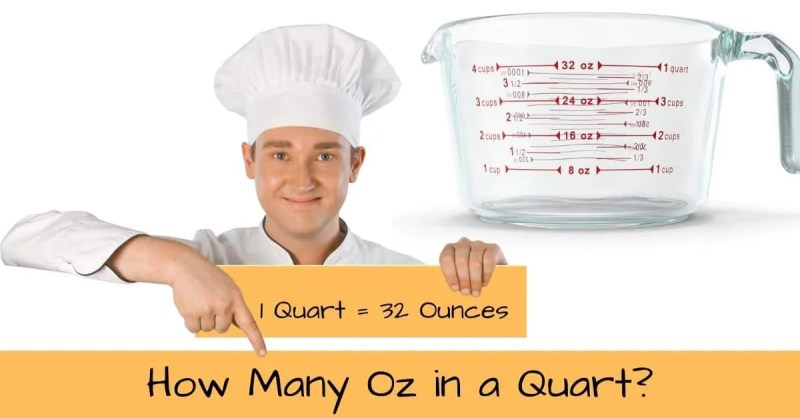
At its core, the relationship between ounces and quarts is a cornerstone of the US customary system, a framework that governs everything from beverage labeling to industrial specifications. Yet, for those unfamiliar with imperial measurements, the leap from fluid ounces to quarts can feel like navigating an unmarked trail. The truth is simpler than it seems: 32 fluid ounces equal exactly one quart. But why? And how did this standard emerge?
The confusion often arises because the term "quart" itself is ambiguous—it can refer to dry quarts (used for grains or solids) or liquid quarts (for fluids). While dry quarts measure 2.11338 pints, the liquid quart, the focus of "how many ounces in a quart" queries, adheres strictly to 32 fluid ounces. This distinction is critical, especially in culinary and scientific fields where precision matters.
The Complete Overview of How Many Ounces in a Quart
The conversion between ounces and quarts is a linchpin of the US customary system, a relic of British imperial measurements that persists in modern American life. For practical purposes, the answer is 32 fluid ounces per quart, but the journey to this standard reveals a system built on trade, agriculture, and standardization. Unlike metric units, which rely on powers of ten, imperial measurements often feel arbitrary—yet their persistence underscores their utility in specific contexts, from brewing to construction.The key to mastering "how many ounces in a quart" lies in recognizing the hierarchy of volume measurements: 1 gallon = 4 quarts, 1 quart = 2 pints, 1 pint = 16 fluid ounces. This structure ensures consistency, but it also demands familiarity. For instance, a half-gallon (2 quarts) contains 64 fluid ounces, a fact critical for everything from mixing concrete to pouring cocktails. The system’s design prioritizes divisibility—halves, quarters, and eighths—making it intuitive for tasks requiring rough estimates.
Historical Background and Evolution
The quart’s origins trace back to medieval England, where ale brewers needed a standardized unit to regulate taxation and quality. The "quart" (from the Latin quartarius, meaning "one-fourth") originally denoted a quarter of a wine gallon, a volume equivalent to about 2.2 liters. By the 14th century, English law codified the wine gallon as 231 cubic inches, a measurement that later influenced the US system after colonization.When the United States adopted its own customary units in the late 18th century, it retained the quart but redefined it for practicality. The liquid quart was standardized at 57.75 cubic inches (or 32 fluid ounces), aligning with the needs of agriculture and trade. Meanwhile, the dry quart—used for grains like wheat or rice—was set at 67.2 cubic inches, reflecting the bulkier volume of solids. This duality explains why "how many ounces in a quart" yields different answers depending on context, though the liquid quart remains the more commonly referenced standard.
Core Mechanisms: How It Works
The mechanics of "how many ounces in a quart" hinge on two principles: volume displacement and unit hierarchy. A fluid ounce is defined as 1.80469 cubic inches, meaning 32 ounces occupy 57.75 cubic inches—the exact volume of a liquid quart. This consistency is maintained through calibrated measuring tools, from kitchen scales to laboratory beakers, ensuring reproducibility.Table of Contents
- The Complete Overview of How Many Ounces in a Quart
- Historical Background and Evolution
- Core Mechanisms: How It Works
- Key Benefits and Crucial Impact
- Major Advantages
- Comparative Analysis
- Future Trends and Innovations
- Conclusion
- Comprehensive FAQs
- Q: Is a quart always 32 ounces?
- Q: Why does the US still use quarts instead of liters?
- Q: How do I convert quarts to ounces for non-liquid ingredients?
- Q: Are there any common mistakes when converting quarts to ounces?
- Q: Can I use quarts and ounces interchangeably in baking?
- Q: How does temperature affect quart-to-ounce conversions?
- Q: What’s the easiest way to remember "how many ounces in a quart"?
- Q: Are there any industries where quarts are more precise than liters?
- Q: How do I convert quarts to ounces for international recipes?
- Q: What’s the difference between a US quart and a UK quart?
- Q: Can I use a quart as a standard for measuring non-liquid items?
In practice, the conversion is straightforward but requires attention to detail. For example:
The US system’s lack of decimal harmony (e.g., 16 ounces in a pint) can seem cumbersome, but it was optimized for manual measurement tools like pint jugs and gallon jugs, which divide cleanly into halves and quarters. This design reflects a pre-industrial era where precision was secondary to ease of use.
Key Benefits and Crucial Impact
Understanding "how many ounces in a quart" transcends mere arithmetic—it’s a gateway to efficiency in fields where volume matters. In cooking, for instance, doubling a recipe hinges on scaling quarts to ounces without spillage or waste. Brewers rely on these conversions to calculate yeast-to-liquid ratios, while chemists use them to dilute solutions with exacting accuracy. Even in everyday life, pouring a quart of milk into an 8-ounce glass requires knowing there are 4 servings per quart.The impact extends to commerce and regulation. Beverage labels must comply with FDA standards, which mandate quart measurements for products like milk or juice. Missteps in these conversions can lead to underfilled containers, legal disputes, or even safety hazards in industrial settings. Historically, the quart’s standardization reduced fraud in trade, ensuring buyers received the advertised volume—a principle still vital today.
> "Measurement is the first step that leads to control and eventually to mastery."
> — Lord Kelvin, physicist and advocate for precise units
Major Advantages
- Precision in Recipes: Baking and cooking demand exact liquid-to-dry ratios; knowing "how many ounces in a quart" prevents over-mixing or under-baking.
- Scientific Accuracy: Lab protocols often use quarts for large-volume reactions, where 32-ounce increments simplify scaling.
- Legal Compliance: Food and beverage packaging laws require quart-based labeling, avoiding misrepresentation.
- Cost Efficiency: Bulk purchasing (e.g., quart-sized ingredients) relies on these conversions to minimize waste.
- Cultural Consistency: Recipes, from Southern fried chicken to New England clam chowder, assume quart measurements as standard.

Comparative Analysis
| Measurement System | Ounces per Quart | Key Use Cases |
|---|---|---|
| US Customary (Liquid) | 32 fluid ounces | Cooking, beverages, FDA-regulated products |
| US Customary (Dry) | ~33.6 fluid ounces | Agriculture, grains, bulk solids |
| Imperial (UK) | 40.233 fluid ounces | Historical recipes, some Commonwealth industries |
| Metric (Liters) | 33.814 fluid ounces per liter | Global science, most non-US recipes |
Future Trends and Innovations
As the world increasingly adopts metric measurements, the relevance of "how many ounces in a quart" may wane in global contexts. However, the US remains an outlier, where imperial units persist in daily life. Innovations like smart measuring cups (with digital conversions) and AI-assisted recipe scaling are bridging the gap, but traditionalists—chefs, brewers, and engineers—continue to rely on quart-to-ounce conversions for their reliability.Emerging trends suggest a hybrid approach: while metric units dominate in science, the US may retain its customary system for cultural and practical reasons. For example, beer brewing guilds still use quarts for fermentation calculations, arguing that imperial units offer finer granularity for small batches. Meanwhile, dual-labeling (quarts and liters) on products like soda cans reflects a transitional phase, catering to both systems.
Conclusion
The answer to "how many ounces in a quart" is more than a numerical fact—it’s a testament to a system designed for practicality, trade, and tradition. Whether you’re a home cook, a scientist, or a historian, grasping this conversion unlocks a deeper understanding of measurement’s role in society. The US customary system may seem archaic, but its persistence proves its utility in contexts where precision and tradition intersect.For those navigating between quarts and ounces, the key takeaway is simplicity: 32 fluid ounces make a quart, and this knowledge is the first step toward mastery in any field where volume matters. As measurement tools evolve, the core principle remains unchanged—accuracy starts with understanding the basics.
Comprehensive FAQs
Q: Is a quart always 32 ounces?
A: Only in the US liquid measurement system. Dry quarts (for grains) measure ~33.6 fluid ounces, and the UK’s imperial quart is 40.233 fluid ounces. Always check the context—cooking typically uses liquid quarts.
Q: Why does the US still use quarts instead of liters?
A: Historical inertia and industry-specific needs. Many US trades (brewing, construction) find quarts more practical for small-scale measurements, while science and global trade have largely shifted to metric units.
Q: How do I convert quarts to ounces for non-liquid ingredients?
A: Use the dry quart standard: 1 dry quart ≈ 33.6 US fluid ounces. For example, 2 dry quarts of rice equal ~67.2 fluid ounces. Kitchen scales often handle this conversion automatically.
Q: Are there any common mistakes when converting quarts to ounces?
A: Yes—confusing dry vs. liquid quarts, misreading imperial labels (e.g., UK recipes), or assuming 16 ounces = 1 quart (which is actually 1 pint). Always verify the system (US customary vs. metric) before converting.
Q: Can I use quarts and ounces interchangeably in baking?
A: No. Baking relies on precise volume-to-weight ratios. For example, a quart of flour by volume weighs ~20 ounces due to packing density. Use a kitchen scale for accuracy, especially with dry ingredients.
Q: How does temperature affect quart-to-ounce conversions?
A: Liquid expansion/contraction due to temperature can slightly alter volume. For instance, a quart of water at 32°F (freezing) is denser than at 212°F (boiling). Most conversions assume room temperature (68°F/20°C) for consistency.
Q: What’s the easiest way to remember "how many ounces in a quart"?
A: Use the mnemonic "32 ounces = 1 quart, 16 ounces = 1 pint"—then double the pint to get the quart. Visualizing a gallon jug (4 quarts) as 128 ounces also reinforces the pattern.
Q: Are there any industries where quarts are more precise than liters?
A: Yes. Brewing and distilling often prefer quarts for small-batch fermentations, as they align better with traditional barrel measurements (e.g., a 5-gallon brew kit uses quarts for yeast calculations). Precision matters when margins are tight.
Q: How do I convert quarts to ounces for international recipes?
A: First, identify if the recipe uses US or metric units. For US quarts, multiply by 32. For metric liters, use 33.814 fluid ounces per liter. Many modern recipes include both for clarity.
Q: What’s the difference between a US quart and a UK quart?
A: The UK’s imperial quart is ~8% larger (40.233 oz vs. 32 oz). This discrepancy can alter recipe outcomes—e.g., a UK quart of milk is roughly 1.25 US quarts. Always specify the system when sharing measurements internationally.
Q: Can I use a quart as a standard for measuring non-liquid items?
A: Dry quarts are designed for this, but they’re less common in households. For bulk items like sugar or grains, use a dry quart measure (or a kitchen scale for accuracy). Never substitute liquid quarts for solids—packing density varies drastically.
Leave a Comment
Comments are moderated before appearing. The data you submit is processed according to the Privacy Policy of Medicine.