The Secret to Surviving 99 Nights in the Forest: A Tactical Guide
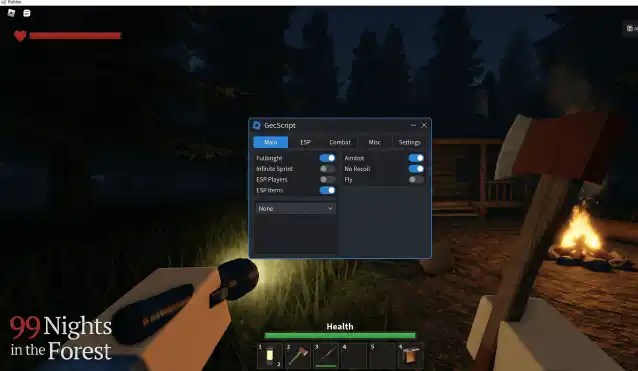
The forest doesn’t forgive mistakes. It rewards preparation, not intention. If you’re serious about how to hack in 99 nights in the forest, you’ll need more than a knife and a lighter—you’ll need a system that turns isolation into an advantage. The first 48 hours are a test of discipline; the next 50 are a test of adaptability. Most people fail by day 3. The ones who make it? They’ve already internalized the rules before stepping into the trees.
This isn’t about roughing it. It’s about hacking the forest’s logic—its rhythms, its dangers, its hidden efficiencies. The key isn’t endurance; it’s optimizing every variable so the environment works for you, not against you. No fluff. No romanticism. Just the mechanics of survival refined into a science.
You’ll need three things: a mental framework to avoid panic, a physical system to sustain energy, and the ability to exploit the forest’s resources before it resets. The rest is just luck—and luck runs out fast when you’re alone for three months.
The Complete Overview of How to Hack in 99 Nights in the Forest
The forest is a closed-loop system. Every action has a reaction, and every resource is finite. The goal isn’t to "survive" but to reprogram your relationship with scarcity. Traditional survival guides teach you to react; this approach teaches you to anticipate and control. For 99 nights, you’ll live in a state of controlled chaos—where fire isn’t just warmth, but a signal; where silence isn’t absence, but a language.
Most people treat the forest as an obstacle. The best operators treat it as a tool. The difference? One group waits for problems; the other engineers solutions before they arise. This isn’t about luck. It’s about systems design. You’ll need to master three domains: psychological conditioning, resource optimization, and tactical movement. Skip any, and the forest will correct you—permanently.
Historical Background and Evolution
The concept of prolonged forest immersion isn’t new. Monks, hermits, and military operatives have tested its limits for centuries, but modern interpretations—like the 99-night challenge—emerge from a fusion of extreme solitude experiments and survival psychology. The idea gained traction in the 1970s with studies on sensory deprivation, later refined by survivalists who realized that the mind breaks before the body. The forest, stripped of modern distractions, becomes a crucible for testing human limits.
Table of Contents
- The Complete Overview of How to Hack in 99 Nights in the Forest
- Historical Background and Evolution
- Core Mechanics: How It Works
- Key Benefits and Crucial Impact
- Major Advantages
- Comparative Analysis
- Future Trends and Innovations
- Conclusion
- Comprehensive FAQs
- Q: Is 99 nights in the forest physically dangerous?
- Q: Do I need special gear, or can I use basic survival tools?
- Q: How do I handle loneliness and mental fatigue?
- Q: Can I do this solo, or should I have a partner?
- Q: What’s the biggest mistake people make when attempting this?
- Q: How do I prepare mentally before starting?
Today, how to hack in 99 nights in the forest blends ancient skills with data-driven efficiency. Traditional survival relies on instinct; modern hacking relies on predictive modeling. You won’t just build a shelter—you’ll calculate wind patterns, insulation thresholds, and structural integrity to ensure it lasts. You won’t just forage—you’ll map edible cycles, poison avoidance, and caloric yield to prevent malnutrition. The evolution isn’t about being tougher; it’s about being smarter than the environment.
Core Mechanics: How It Works
The forest operates on two layers: the visible and the invisible. The visible is fire, food, and shelter—the basics. The invisible is mental fatigue, circadian disruption, and resource depletion. Most people fail when they ignore the invisible. The hack? Treat the forest like a machine with levers. Pull the right one, and it feeds you. Pull the wrong one, and it starves you.
Your first move is decoupling from linear time. A clock is useless here. Instead, you’ll track biological cycles: hunger, sleep, and energy peaks. Your second move is resource stacking—layering firewood, water sources, and food caches so no single failure dooms you. The third? Controlled exposure. You’ll engineer micro-adventures—short forays to break routine, but never so far that you risk getting lost. The forest rewards precision; it punishes recklessness.
Key Benefits and Crucial Impact
There’s a reason elite soldiers, CEOs, and artists seek out how to hack in 99 nights in the forest: it’s the ultimate stress test. The benefits aren’t just physical—they’re cognitive and emotional recalibrations. You’ll return with a rewired tolerance for ambiguity, a sharper focus on priorities, and an immunity to modern distractions. The impact? It’s not just survival—it’s transformation.
But the cost is real. The first 72 hours will feel like a fever dream. Your brain will rebel. Your body will protest. The only way through is to accept the discomfort as part of the process. The forest doesn’t care about your comfort—it cares about your adaptability. Those who crack under pressure? They never learn the system. Those who endure? They master it.
"The forest doesn’t teach; it tests. You don’t pass or fail—you either learn or you don’t." — John McPhee, Survival Psychologist
Major Advantages
- Psychological Resilience: Prolonged isolation forces you to confront fear, loneliness, and doubt. By day 30, you’ll have rewired your stress response—a skill that transfers to high-pressure environments.
- Resource Mastery: You’ll learn to read the land like a blueprint, identifying edible plants, water sources, and shelter spots with near-instant intuition.
- Energy Optimization: Traditional survival burns calories fast. The hack? Minimalist movement and metabolic efficiency—you’ll move less, conserve more, and avoid the "hunger trap" that dooms most long-term survivors.
- Sensory Clarity: Without modern noise, your hearing sharpens, your smell becomes hyper-sensitive, and your peripheral vision expands. The forest becomes a high-definition experience.
- Decision-Making Under Uncertainty: Every choice has consequences. You’ll develop rapid, high-stakes judgment skills that eliminate hesitation.

Comparative Analysis
| Traditional Survival | Modern Forest Hacking |
|---|---|
| Relies on instinct and improvisation. | Uses predictive systems and pre-planned redundancies. |
| Fire is for warmth and cooking. | Fire is a multi-purpose tool: signal, purification, psychological anchor. |
| Shelter is basic protection. | Shelter is a calorically efficient, weather-proofed, and stealth-optimized system. |
| Food is scavenged as needed. | Food is pre-cached, cycle-tracked, and nutritionally balanced. |
Future Trends and Innovations
The next evolution of how to hack in 99 nights in the forest will blend biotech and data science. Imagine wearable sensors tracking hydration and stress in real-time, or AI-assisted foraging apps that predict edible cycles. The forest isn’t changing—but our tools are. The future belongs to those who turn survival into a science.
Right now, the biggest innovation is hybrid training. Military units and elite athletes are already using simulated forest immersion in controlled environments to condition the mind before real exposure. The goal? To eliminate the learning curve. Soon, 99 nights won’t be a test of endurance—it’ll be a test of execution.

Conclusion
How to hack in 99 nights in the forest isn’t about enduring—it’s about dominating the variables. The forest will try to break you. But if you’ve prepared the right way, it will only make you stronger. The key? Stop thinking like a survivor and start thinking like an engineer. Every element—fire, food, shelter, mindset—is a tunable system. Master the levers, and the forest becomes your ally.
The first step? Commit fully. No half-measures. No "just trying it out." If you’re serious, you’ll treat this as a high-stakes experiment—because it is. The forest doesn’t care about your intentions. It only respects your preparation.
Comprehensive FAQs
Q: Is 99 nights in the forest physically dangerous?
A: Yes, but the risks are manageable with the right systems. Hypothermia, dehydration, and malnutrition are real threats—but they’re avoidable if you pre-plan redundancies. The bigger danger is psychological collapse, which is why mental conditioning is non-negotiable.
Q: Do I need special gear, or can I use basic survival tools?
A: Basic tools work, but optimized gear makes the difference between struggle and efficiency. A fixed-blade knife, water filter, and high-calorie rations are essential. The hack? Customize everything for minimal weight and maximum utility—no unnecessary bulk.
Q: How do I handle loneliness and mental fatigue?
A: The forest is a mirror for the mind. To combat loneliness, use structured routines, controlled exploration, and sensory stimulation (e.g., whittling wood, journaling). Mental fatigue is managed by cycling high-focus and low-focus tasks—never let your brain idle.
Q: Can I do this solo, or should I have a partner?
A: Solo is harder but more psychologically revealing. A partner adds safety but can also dilute focus. If solo, ensure you’ve pre-mapped escape routes and backup plans. If paired, define roles clearly—one person handles resources, the other handles movement.
Q: What’s the biggest mistake people make when attempting this?
A: Underestimating the invisible costs. Most fail because they focus only on physical needs—fire, food, shelter—while ignoring mental fatigue, sleep deprivation, and sensory overload. The forest doesn’t just test your body; it tests your adaptability.
Q: How do I prepare mentally before starting?
A: Start with short solitude sessions (24-48 hours) to build tolerance. Use visualization techniques to rehearse challenges. Most importantly, accept that discomfort is temporary—the goal isn’t to avoid it, but to outlast it.
Leave a Comment
Comments are moderated before appearing. The data you submit is processed according to the Privacy Policy of Medicine.