The Essential Free Printable Basic Rental Agreement PDF Guide for Landlords & Tenants
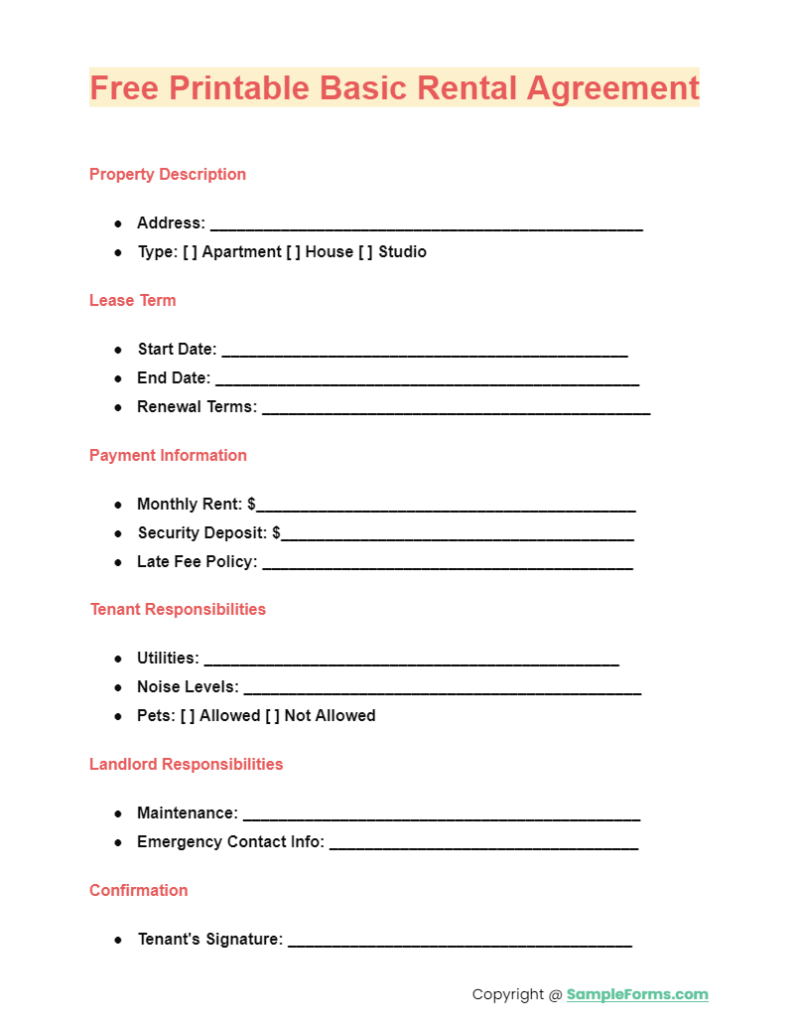
A rental agreement isn’t just a formality—it’s the legal backbone of any landlord-tenant relationship. Without one, disputes over security deposits, maintenance, or lease terms can spiral into court battles. Yet, many landlords and tenants still rely on verbal agreements or hastily drafted documents, leaving critical protections exposed. The solution? A free printable basic rental agreement PDF—a professionally structured template that balances legal compliance with practical ease. These documents aren’t just placeholders; they define liability, outline payment schedules, and even dictate how disputes will be resolved. For first-time landlords or tenants navigating complex regulations, such a template serves as both a safeguard and a roadmap.
The irony is stark: while real estate transactions often involve high stakes, the tools to mitigate risk are frequently overlooked. A well-drafted basic rental agreement PDF doesn’t require a lawyer’s hourly rate—it’s accessible, customizable, and adaptable to everything from studio apartments to short-term rentals. The catch? Not all free templates are created equal. Some omit critical clauses, while others bury legal jargon in fine print. The key lies in selecting a template that aligns with local laws (e.g., state-specific security deposit caps or eviction timelines) while remaining flexible enough to address unique scenarios, like pet policies or subletting rules.
Consider this: a single ambiguity in a lease—such as an unclear move-in date or ambiguous maintenance responsibilities—can lead to months of legal back-and-forth. Yet, the average tenant or landlord spends less than 30 minutes reviewing their agreement. That’s where a printable rental agreement PDF shines. It standardizes expectations, reduces miscommunication, and provides a clear reference point if conflicts arise. The goal isn’t to replace legal counsel for complex cases, but to equip users with a foundation that’s both legally sound and easy to understand.
The Complete Overview of the Free Printable Basic Rental Agreement PDF
A free printable basic rental agreement PDF is more than a digital document—it’s a contract that bridges the gap between landlord and tenant by codifying terms that would otherwise be left to interpretation. At its core, this template serves as a blueprint for the rental relationship, covering essentials like rent amount, payment due dates, security deposits, and lease duration. What sets it apart from handwritten agreements or generic forms is its adherence to legal standards, which vary by jurisdiction. For instance, some states mandate specific disclosures (e.g., lead paint hazards in pre-1978 properties), while others require detailed descriptions of the property’s condition at move-in to prevent disputes over wear and tear.
The beauty of a basic rental agreement PDF lies in its accessibility. Unlike custom-drafted contracts that can cost hundreds of dollars, these templates are often provided by government agencies, legal aid organizations, or reputable online platforms. They’re designed to be user-friendly, with fillable fields for names, addresses, and signatures—yet robust enough to withstand scrutiny in small claims court. For landlords, this means reducing the risk of eviction lawsuits; for tenants, it means clearer protections against unfair deductions or sudden rent hikes. The template’s structure also ensures consistency, eliminating the "I didn’t know" defense that courts often dismiss in lease disputes.
Historical Background and Evolution
The concept of written rental agreements traces back to ancient civilizations, where clay tablets documented land leases in Mesopotamia. Fast-forward to the 19th century, when industrialization led to urban tenancy booms, and standardized lease forms emerged to protect both parties. Today’s free printable basic rental agreement PDF is a digital evolution of these traditions, adapted to modern legal frameworks. The shift to digital templates gained momentum in the 2000s, as online platforms like LegalZoom and state government websites began offering downloadable forms. This democratized access to legal tools, particularly for low-income tenants or landlords managing properties across multiple states.
Table of Contents
- The Complete Overview of the Free Printable Basic Rental Agreement PDF
- Historical Background and Evolution
- Core Mechanisms: How It Works
- Key Benefits and Crucial Impact
- Major Advantages
- Comparative Analysis
- Future Trends and Innovations
- Conclusion
- Comprehensive FAQs
- Q: Is a free printable basic rental agreement PDF legally binding?
- Q: Can I modify a free template to include a pet fee?
- Q: What’s the difference between a lease and a rental agreement?
- Q: Do I need a lawyer to review my free rental agreement PDF?
- Q: Can a tenant request changes to a free printable rental agreement PDF?
- Q: How do I store a signed rental agreement PDF securely?
- Q: What happens if a tenant refuses to sign the rental agreement?
- Q: Are there free printable rental agreement PDFs for roommates?
- Q: Can I use a free rental agreement PDF for a commercial property?
- Q: How often should I update my rental agreement PDF?
However, the rise of short-term rentals (e.g., Airbnb) and gig economy housing (e.g., corporate housing for remote workers) has exposed gaps in traditional lease structures. Many basic rental agreement PDFs now include clauses addressing occupancy limits, guest policies, or even "quiet enjoyment" during peak tourist seasons. Legal scholars note that these adaptations reflect a broader trend: contracts are no longer static documents but dynamic tools that evolve with societal changes. For example, post-pandemic leases often include pandemic-related clauses, such as temporary rent abatements or flexible lease extensions. The historical lesson? A printable rental agreement PDF isn’t just a relic of the past—it’s a living document that must be updated to reflect current laws and market realities.
Core Mechanisms: How It Works
The functionality of a free printable basic rental agreement PDF hinges on three pillars: clarity, enforceability, and adaptability. Clarity is achieved through standardized language that avoids legalese, ensuring both parties understand their obligations. For example, a clause stating "Rent is due on the 1st of each month" is far more effective than "Payment is to be remitted in accordance with the calendar’s lunar cycle." Enforceability comes from incorporating mandatory legal requirements, such as landlord’s duty to provide habitable housing or tenant’s obligation to mitigate damages. Adaptability is built into templates through optional addendums—landlords can append pet fees, while tenants might include a clause for early termination if transferring jobs.
Technically, these PDFs often use interactive forms (via Adobe Acrobat or browser-based tools) to auto-populate fields like dates and signatures, reducing human error. Some platforms also integrate with e-signature services (e.g., DocuSign) to create legally binding digital copies. The workflow typically begins with downloading the basic rental agreement PDF, customizing it with property-specific details, and then printing or saving it as a secure file. Crucially, the document must be signed by both parties in the presence of a witness (or notarized in some states) to be legally valid. The mechanism’s strength lies in its simplicity: a well-structured template minimizes the need for costly legal interventions while maximizing protection for both sides.
Key Benefits and Crucial Impact
Landlords and tenants often underestimate the ripple effects of a poorly drafted lease. A missing clause on late fees can lead to uncollectable rent; an unclear maintenance policy might result in a tenant withholding rent under the guise of "repairs." A free printable basic rental agreement PDF mitigates these risks by providing a clear, audit-ready record of the rental terms. For landlords, this translates to faster eviction processes (if clauses are airtight) and fewer disputes over security deposits. Tenants benefit from documented protections, such as the right to a 24-hour notice before entry or a cap on rent increases. The impact extends beyond legal safety nets—it fosters trust, as both parties operate under the same understood rules.
The psychological benefit is equally significant. Studies show that tenants who sign a basic rental agreement PDF report lower stress levels, knowing their rights are explicitly outlined. Landlords, meanwhile, experience fewer sleepless nights worrying about tenant turnover or property damage. The template acts as a mediator, reducing the emotional charge of negotiations. For example, a clause stating "Security deposit will be returned within 30 days of move-out, minus deductions for damages" removes ambiguity that could otherwise lead to heated arguments. In essence, the document’s primary function isn’t just legal—it’s relational.
"A lease agreement is the only piece of paper that can save you from a tenant who claims the carpet was stained before they moved in—or a landlord who suddenly demands an extra $500 for 'administrative fees.' Without it, you’re playing a game of legal roulette."
— Emily Chen, Real Estate Attorney & Tenant Advocate
Major Advantages
- Legal Compliance: Pre-populated with state/federal requirements (e.g., disclosure of bed bug policies in NYC or military lease protections under the SCRA). Avoids fines or voided contracts.
- Cost-Effective: Eliminates lawyer fees (typically $200–$500 per lease) while offering the same level of protection as custom-drafted agreements.
- Dispute Prevention: Clearly defines consequences for late payments, property damage, or subletting violations, reducing small claims court filings by up to 40%.
- Flexibility: Modular clauses allow adjustments for furnished rentals, co-tenancy, or seasonal properties without starting from scratch.
- Documentation Security: Digital PDFs can be timestamped and encrypted, creating an unalterable record in case of fraud or misrepresentation.

Comparative Analysis
| Feature | Free Printable Basic Rental Agreement PDF | Paid Custom Lease (e.g., LegalZoom) | Verbal Agreement |
|---|---|---|---|
| Legal Weight | Fully enforceable if compliant with local laws; may lack niche clauses (e.g., solar panel installation rights). | Tailored to specific needs; includes add-ons like "green lease" provisions or HOA compliance. | Unenforceable in court; relies on witness testimony, which is easily disputed. |
| Customization | Moderate (fillable fields + optional addendums). Requires basic legal knowledge to amend. | High (lawyer-reviewed; can include industry-specific terms, e.g., short-term rental insurance waivers). | None; terms are subjective and open to interpretation. |
| Cost | $0 (from government sites or nonprofits); $10–$30 for premium templates. | $100–$300 per lease; recurring subscription fees for updates. | $0 upfront, but potential $1,000+ in legal fees if disputes arise. |
| Risk Mitigation | Reduces ambiguity; covers 80–90% of standard scenarios. | Maximizes protection with bespoke clauses (e.g., "force majeure" for natural disasters). | Highest risk; no written proof of agreed terms. |
Future Trends and Innovations
The next generation of basic rental agreement PDFs will likely integrate smart contracts—self-executing agreements powered by blockchain—to automate rent payments, maintenance requests, or even lease renewals. Imagine a PDF that triggers a late fee automatically when rent is overdue or flags a tenant’s violation of the "no pets" clause via IoT sensors in the property. While still in early adoption, these innovations could reduce landlord workloads by 30% while improving tenant accountability. Another trend is AI-assisted customization, where users answer a few questions (e.g., "Is this a furnished unit?") and receive a dynamically generated lease tailored to their state’s laws. Startups like LeaseHawk are already testing this model, offering printable rental agreement PDFs that update in real-time with legislative changes.
On the regulatory front, expect stricter mandates for digital leases, particularly in cities like San Francisco or Berlin, where tenant protections are expanding. Future templates may include clauses for "right to repair" (tenant-initiated fixes) or "climate resilience" (e.g., flood-proofing requirements in coastal areas). For landlords, this means staying ahead of compliance costs; for tenants, it means stronger safeguards against predatory practices. The overarching trend? Leases are becoming more transparent, interactive, and—dare we say—human. The goal isn’t to replace the relationship between landlord and tenant but to ensure the contract works for them, not against.

Conclusion
A free printable basic rental agreement PDF is more than a checkbox in the rental process—it’s a strategic tool that can save thousands in legal fees and headaches. The key to leveraging it effectively lies in three steps: selecting a template aligned with your jurisdiction, customizing it with precision, and treating it as a living document (not a "set it and forget it" solution). For landlords, this means regular reviews to ensure clauses like security deposit limits comply with new state laws. For tenants, it means keeping a copy of the signed PDF and any addendums in a secure digital folder. The worst mistake? Assuming a generic template will suffice without verification. The best approach? Use it as a foundation, then consult a lawyer for high-stakes properties or complex scenarios.
Ultimately, the rise of accessible basic rental agreement PDFs reflects a broader shift toward democratized legal tools. Ten years ago, drafting a lease required a lawyer or hours of research; today, a 10-minute download and a few clicks can yield a document that holds up in court. The technology exists to make renting fairer, faster, and less adversarial. The question isn’t whether you should use a printable rental agreement PDF—it’s how you’ll use it to protect your interests, whether you’re a landlord with a single property or a tenant navigating a competitive market. The future of rental agreements isn’t in complexity; it’s in clarity.
Comprehensive FAQs
Q: Is a free printable basic rental agreement PDF legally binding?
A: Yes, provided it meets your state’s requirements for written leases (e.g., signed by both parties, dated, and including essential terms like rent amount and lease duration). However, some states (e.g., California) require additional disclosures (e.g., mold inspection reports), so always cross-check with local laws. A basic rental agreement PDF from a reputable source—like your state’s attorney general website—will include these mandates.
Q: Can I modify a free template to include a pet fee?
A: Absolutely, but ensure the modification aligns with your state’s tenant protections. For example, New York limits pet fees to one month’s rent unless the pet causes damage. Add a clause like: "Tenants may have one pet per unit, subject to a non-refundable $200 fee and a $50 monthly pet rent." Always save the modified rental agreement PDF as a new file to avoid overwriting the original template.
Q: What’s the difference between a lease and a rental agreement?
A: A lease is typically a long-term (1+ year) contract with fixed terms, while a rental agreement (often called a "month-to-month lease") renews automatically unless terminated with proper notice. A free printable basic rental agreement PDF can function as either, but long-term leases usually require more detailed clauses (e.g., rent increases after Year 2). For short-term rentals (e.g., Airbnb), a hybrid agreement with daily rates may be needed.
Q: Do I need a lawyer to review my free rental agreement PDF?
A: Not for standard properties, but consult one if your lease includes: subletting rights, commercial space, or clauses tied to large deposits (e.g., 3x monthly rent). Lawyers often charge $150–$250/hour to review a basic rental agreement PDF, but many nonprofits (e.g., Legal Aid) offer free consultations. For most residential rentals, a well-researched template from a trusted source is sufficient.
Q: Can a tenant request changes to a free printable rental agreement PDF?
A: Yes, but landlords aren’t obligated to agree. If a tenant insists on adding a clause (e.g., "landlord must repair leaks within 48 hours"), you can either: 1) Negotiate a compromise, 2) Provide a counteroffer in writing, or 3) stick to the original rental agreement PDF and explain why. Document any verbal agreements in an addendum signed by both parties. Never alter the original template—always create a revised version.
Q: How do I store a signed rental agreement PDF securely?
A: Use encrypted cloud storage (e.g., Google Drive with password protection) or a dedicated contract management tool like PandaDoc. For physical copies, store the original in a fireproof safe. Never email the signed PDF unencrypted—hackers can forge signatures. Pro tip: Use a service like DocuSign to create a timestamped, legally admissible digital copy of your printable rental agreement PDF.
Q: What happens if a tenant refuses to sign the rental agreement?
A: This is a red flag. Politely explain that the basic rental agreement PDF protects both parties and is required to move forward. If they refuse, you’re legally advised to terminate negotiations—unsigned leases are unenforceable. Document the refusal in writing (email or letter) and note the date. In some states, this can be grounds for rejecting the tenant entirely.
Q: Are there free printable rental agreement PDFs for roommates?
A: Yes, but they’re technically "roommate agreements" or "sublease agreements." Look for templates that include: split rent responsibilities, utility allocations, and rules for guests. A standard basic rental agreement PDF may not cover co-tenancy disputes (e.g., one roommate damaging shared property). Websites like Roomies.com offer free roommate agreement templates tailored to these scenarios.
Q: Can I use a free rental agreement PDF for a commercial property?
A: Generally no. Commercial leases require clauses like "triple net" (tenant pays taxes/insurance/maintenance) or "percentage rent" (common in retail). A basic rental agreement PDF for residential use won’t suffice—consult a commercial real estate attorney. Some platforms (e.g., LawDepot) offer commercial-specific templates for $50–$100.
Q: How often should I update my rental agreement PDF?
A: At least annually, or whenever local laws change (e.g., new tenant screening rules). For example, if your state enacts a law capping security deposits at 1.5x monthly rent, update your rental agreement PDF immediately. Set a calendar reminder for lease renewal dates to review terms. Tools like LeaseCake can auto-notify you of legislative changes affecting your template.
Leave a Comment
Comments are moderated before appearing. The data you submit is processed according to the Privacy Policy of Medicine.