The Hidden Math Behind What Is the Lowest Common Multiple of 7 and 5

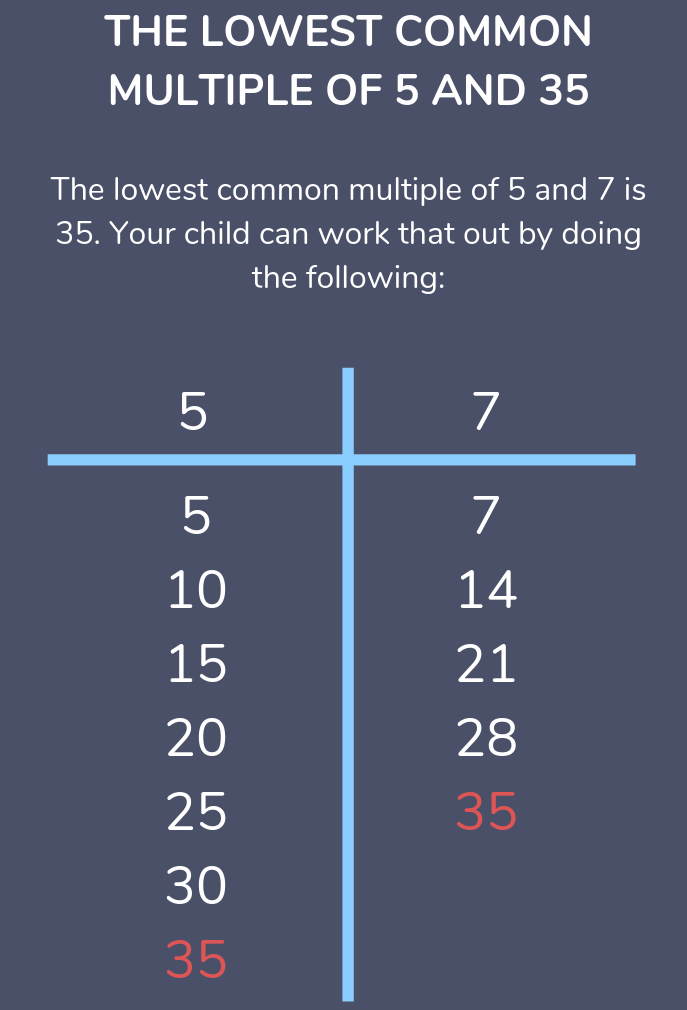
The number 35 carries an unsuspecting power—it’s the smallest number divisible by both 7 and 5 without a remainder. This seemingly simple fact is the answer to what is the lowest common multiple of 7 and 5, a question that reveals deeper patterns in arithmetic, algebra, and even computer science. At first glance, the relationship between these two primes appears trivial, yet their interplay exemplifies how fundamental operations like multiplication and division form the backbone of more complex systems. From cryptography to scheduling algorithms, understanding why 35 emerges as the least common multiple (LCM) of 7 and 5 illuminates how mathematics transcends abstract symbols to solve tangible problems.
The elegance of this calculation lies in its simplicity: 7 × 5 = 35, and no smaller positive integer satisfies the condition of being divisible by both. But why does this matter beyond the classroom? Because the LCM isn’t just a theoretical exercise—it’s a tool for synchronization. Whether aligning repeating cycles in astronomy, optimizing resource allocation in logistics, or ensuring error-free data transmission in digital signals, the principle of finding a shared multiple underpins efficiency. The question what is the lowest common multiple of 7 and 5 thus becomes a gateway to exploring how mathematics harmonizes disparate elements into cohesive solutions.
Beyond the numbers themselves, the process of deriving the LCM exposes the interplay between prime factors and their multiplicative properties. While 7 and 5 are both primes—numbers divisible only by 1 and themselves—their product reveals a critical insight: the LCM of two numbers is their product when they are co-prime (i.e., share no common divisors other than 1). This relationship isn’t coincidental; it’s a manifestation of the Fundamental Theorem of Arithmetic, which states that every integer greater than 1 has a unique prime factorization. The LCM, in this context, becomes a testament to the theorem’s predictive power, where the absence of shared factors simplifies the calculation to a straightforward multiplication.
The Complete Overview of What Is the Lowest Common Multiple of 7 and 5
The concept of the lowest common multiple (LCM) of two integers is a cornerstone of elementary number theory, yet its implications extend far beyond basic arithmetic. When posed with what is the lowest common multiple of 7 and 5, one might initially dismiss the question as overly simplistic—until recognizing that it encapsulates a broader mathematical philosophy: the search for minimal commonality in a system defined by discrete, often prime, components. The LCM of 7 and 5 is 35, but the significance lies in the method of arriving at this answer. For numbers that are co-prime (like 7 and 5), the LCM is simply their product, a rule that stems from the absence of overlapping prime factors. This property isn’t just a shortcut; it’s a reflection of how mathematical structures can be reduced to their most efficient forms when constraints are understood.The practical utility of this concept becomes apparent when considering real-world scenarios where synchronization is critical. For instance, in music, the LCM determines the smallest interval at which two rhythms with periods of 7 and 5 beats will realign. Similarly, in computer science, the LCM helps design algorithms that process data in batches of varying sizes, ensuring no resource is left underutilized. The question what is the lowest common multiple of 7 and 5 thus serves as a microcosm for understanding how mathematical abstractions translate into actionable strategies across disciplines. Even in everyday contexts—such as scheduling meetings that recur every 7 and 5 days—the LCM provides the optimal timeframe for alignment, minimizing wasted time and maximizing efficiency.
Historical Background and Evolution
The study of common multiples dates back to ancient civilizations, where arithmetic was not merely an academic pursuit but a necessity for trade, astronomy, and calendar construction. The Babylonians, for example, used LCM-like principles to align their lunar and solar cycles, ensuring their calendar remained synchronized with natural phenomena. Their clay tablets contain problems akin to what is the lowest common multiple of 7 and 5, though framed in the context of practical measurement. The Greeks later formalized these ideas, with Euclid’s Elements (c. 300 BCE) introducing algorithms for finding greatest common divisors (GCD), which are inversely related to LCMs. The relationship between GCD and LCM—expressed as LCM(a, b) = (a × b) / GCD(a, b)—was a breakthrough that connected two seemingly distinct concepts under a unified framework.The evolution of LCM as a mathematical tool gained momentum during the Renaissance, as algebra emerged as a discipline. Mathematicians like Fibonacci and later Descartes applied LCM principles to solve problems in proportion and ratio, laying the groundwork for modern number theory. The 19th century saw the formalization of prime factorization, which demystified the LCM calculation for co-prime numbers like 7 and 5. Today, the concept is taught globally as a fundamental skill, not just for its theoretical elegance but for its role in computational efficiency. The historical trajectory of the LCM reflects a broader trend in mathematics: the transformation of practical needs into abstract systems that, in turn, solve problems at scales unimaginable to ancient scholars.
Core Mechanisms: How It Works
The mechanism behind determining what is the lowest common multiple of 7 and 5 hinges on two key operations: prime factorization and the identification of the highest powers of all primes present in the numbers. For 7 and 5, the process is straightforward because both are primes. Since they share no common prime factors, their LCM is simply their product: 7 × 5 = 35. However, the method becomes more nuanced with composite numbers. For example, to find the LCM of 12 and 18, one would first factorize them: 12 = 2² × 3, and 18 = 2 × 3². The LCM is then 2² × 3² = 36, derived by taking the highest power of each prime present in either number.Table of Contents
- The Complete Overview of What Is the Lowest Common Multiple of 7 and 5
- Historical Background and Evolution
- Core Mechanisms: How It Works
- Key Benefits and Crucial Impact
- Major Advantages
- Comparative Analysis
- Future Trends and Innovations
- Conclusion
- Comprehensive FAQs
- Q: Why is the LCM of 7 and 5 simply their product?
- Q: How does LCM differ from least common denominator (LCD) in fractions?
- Q: Can the LCM of two numbers ever be smaller than the larger number?
- Q: What role does LCM play in modular arithmetic?
- Q: Are there real-world examples where LCM is used in non-mathematical fields?
- Q: How would you find the LCM of three numbers, like 7, 5, and 3?
This method is rooted in the Fundamental Theorem of Arithmetic, which guarantees that every integer greater than 1 has a unique prime signature. The LCM calculation leverages this uniqueness to ensure consistency. When applied to what is the lowest common multiple of 7 and 5, the theorem simplifies the process to its purest form: since 7 and 5 are distinct primes, their LCM is their product. This efficiency is why LCM is favored in algorithms—it minimizes computational steps by exploiting the inherent properties of prime numbers. The core mechanism, therefore, is not just about multiplication but about understanding the structural integrity of numbers themselves.
Key Benefits and Crucial Impact
The LCM’s role in mathematics extends beyond academic exercises into domains where precision and efficiency are paramount. In engineering, for instance, LCM calculations ensure that mechanical systems with different rotational speeds operate harmoniously, preventing wear and tear. In computer science, the LCM optimizes memory allocation and task scheduling, reducing latency in multi-threaded processes. Even in finance, LCM principles help align payment cycles for loans or subscriptions, ensuring no party is left in a state of uncertainty. The answer to what is the lowest common multiple of 7 and 5 may seem trivial, but its underlying logic scales to solve problems where alignment is critical.The impact of LCM is further amplified by its inverse relationship with the greatest common divisor (GCD). While GCD measures the largest number that divides two integers, LCM measures the smallest number that they both divide into. This duality allows mathematicians to approach problems from opposite ends, often simplifying complex systems. For example, in cryptography, LCM and GCD are used to design secure key exchanges, where the product of two primes (as in RSA encryption) relies on the difficulty of factoring large numbers—a problem where LCM’s simplicity contrasts with the complexity of its applications.
"Mathematics is the art of giving the same name to different things." — Henri Poincaré
In the case of LCM, that "same name" is the smallest number that unifies disparate elements under a common denominator, whether those elements are beats in a musical composition or cycles in a machine.
Major Advantages
- Efficiency in Synchronization: LCM minimizes the time or resources required to align periodic events, from traffic light cycles to software updates. For what is the lowest common multiple of 7 and 5, the answer (35) ensures the next alignment occurs in the shortest possible interval.
- Simplification of Complex Systems: By reducing problems to their prime components, LCM calculations avoid redundant computations, making algorithms faster and more scalable.
- Error Reduction in Engineering: In mechanical and electrical systems, LCM-based designs prevent misalignment, reducing the risk of failure. For example, gears with periods of 7 and 5 teeth will mesh correctly every 35 rotations.
- Foundation for Advanced Mathematics: LCM and GCD are building blocks for number theory, algebra, and even abstract algebra, where they help define concepts like lattice structures and ideals.
- Practical Applications in Daily Life: From scheduling recurring appointments to dividing resources equitably, LCM provides a mathematical framework for fairness and efficiency in mundane tasks.
Comparative Analysis
| Aspect | Lowest Common Multiple (LCM) | Greatest Common Divisor (GCD) |
|---|---|---|
| Definition | The smallest positive integer divisible by both numbers (e.g., LCM of 7 and 5 is 35). | The largest positive integer that divides both numbers without a remainder (e.g., GCD of 7 and 5 is 1). |
| Relationship | LCM(a, b) = (a × b) / GCD(a, b). For co-primes, LCM(a, b) = a × b. | GCD is used to derive LCM and vice versa. |
| Applications | Scheduling, synchronization, algorithm optimization. | Simplifying fractions, cryptography, modular arithmetic. |
| Complexity for Primes | O(1) if numbers are co-prime (e.g., 7 and 5). | O(1) for primes (always 1). |
Future Trends and Innovations
As mathematics continues to intersect with emerging fields like quantum computing and artificial intelligence, the principles underlying what is the lowest common multiple of 7 and 5 are poised to evolve. Quantum algorithms, for instance, may exploit the LCM’s properties to accelerate computations in optimization problems, where finding minimal commonalities is critical. Similarly, AI-driven scheduling systems could leverage LCM-based heuristics to dynamically adjust resource allocation in real-time, adapting to unpredictable variables. The future of LCM lies not in its static definition but in its dynamic applications—where the concept serves as a bridge between discrete mathematics and continuous, adaptive systems.Another frontier is the integration of LCM with cryptographic protocols. As encryption methods grow more sophisticated, the interplay between LCM and prime factorization could lead to breakthroughs in secure communication, particularly in post-quantum cryptography. Even in biology, LCM-like principles are being explored to model the synchronization of neural firing patterns or genetic sequences. The question what is the lowest common multiple of 7 and 5 thus opens a window into a future where mathematical fundamentals are repurposed to solve problems at the intersection of technology, science, and human ingenuity.

Conclusion
The answer to what is the lowest common multiple of 7 and 5—35—is more than a numerical result; it’s a microcosm of how mathematics transforms abstract ideas into practical solutions. What begins as a simple multiplication of two primes reveals a deeper truth: that the LCM is a tool for harmony, a method to find common ground in systems defined by diversity. From ancient calendars to modern algorithms, the principle persists because it addresses a universal need—synchronization. The elegance of the LCM lies in its ability to distill complexity into a single, minimal solution, whether that solution is a number like 35 or a strategy for optimizing global supply chains.As mathematics progresses, the LCM’s role will expand, but its core remains unchanged: to provide the smallest framework within which disparate elements can coexist. The next time you encounter what is the lowest common multiple of 7 and 5, remember that you’re not just solving an equation—you’re engaging with a concept that has shaped civilizations, powered industries, and continues to redefine what’s possible.
Comprehensive FAQs
Q: Why is the LCM of 7 and 5 simply their product?
Because 7 and 5 are co-prime (their greatest common divisor is 1), the LCM formula reduces to LCM(a, b) = a × b. This is a special case of the general formula LCM(a, b) = (a × b) / GCD(a, b), where GCD(7, 5) = 1.
Q: How does LCM differ from least common denominator (LCD) in fractions?
The LCM of two numbers is the smallest number both divide into evenly, while the LCD is the LCM of the denominators when adding or subtracting fractions. For example, the LCD of 1/7 and 1/5 is 35, which is also their LCM.
Q: Can the LCM of two numbers ever be smaller than the larger number?
No. The LCM of two numbers is always at least as large as the larger of the two. For 7 and 5, the LCM (35) is larger than both, but for numbers like 4 and 8, the LCM is 8, which equals the larger number.
Q: What role does LCM play in modular arithmetic?
In modular arithmetic, the LCM helps determine the periodicity of congruences. For example, if two cycles have periods of 7 and 5, their combined period is the LCM (35), meaning the system repeats every 35 units.
Q: Are there real-world examples where LCM is used in non-mathematical fields?
Yes. In music, the LCM of note durations determines when two rhythms will realign. In astronomy, it helps predict when planetary cycles (e.g., Venus’s 584-day orbit and Earth’s 365-day year) will coincide. Even in sports, LCM principles optimize scheduling for events with varying frequencies.
Q: How would you find the LCM of three numbers, like 7, 5, and 3?
First find the LCM of two numbers (e.g., LCM of 7 and 5 is 35), then find the LCM of that result with the third number. So, LCM(35, 3) = 105. The general method is to iteratively apply the LCM operation.
Leave a Comment
Comments are moderated before appearing. The data you submit is processed according to the Privacy Policy of Medicine.