The Hidden Power of Words: What Is Figurative Language and Why It Shapes How We Think

Language is not merely a tool for transaction—it is a canvas for meaning. When we describe a leader as "a rock in a storm" or call a decision "a bridge too far," we are not speaking literally. These phrases, rooted in what is figurative language, do more than convey information; they evoke emotion, paint mental images, and bind audiences together through shared understanding. The difference between saying "the project was difficult" and "we waded through a swamp of bureaucracy" lies in the latter’s ability to immerse the listener in experience rather than just stating facts.
The art of understanding figurative language is ancient, yet its mechanisms remain underappreciated in everyday discourse. Poets, politicians, and marketers all wield it deliberately, but its power extends beyond rhetoric. Neuroscientists now study how metaphors shape perception, while cognitive linguists trace their origins to the way humans categorize abstract concepts. Even in digital communication—where brevity often replaces nuance—figurative expressions persist as shorthand for complexity. The question is no longer whether we use figurative language examples, but how consciously we deploy them.
The Complete Overview of What Is Figurative Language
At its core, what is figurative language refers to the use of words or phrases that deviate from their literal meanings to create vivid, layered, or emotional effects. Unlike denotative language (which relies on dictionary definitions), figurative expressions rely on connotation—associations, cultural context, and subtext. When a musician describes their sound as "a symphony of chaos," they are not claiming their work is literally chaotic; they are inviting listeners to feel the tension between order and disorder. This deviation from reality is not a flaw but a feature, one that enriches communication by making it more memorable, persuasive, and human.The study of figurative language in literature reveals its versatility. It can soften harsh truths (e.g., "time heals all wounds"), exaggerate for emphasis (hyperbole), or create parallels between unrelated ideas (metaphor). Even in non-literary contexts—such as corporate slogans ("Think Different") or legal arguments ("the slippery slope")—figurative devices shape how messages are received. The key lies in the audience’s ability to decode these layers, a skill honed through exposure to both formal and informal language use.
Historical Background and Evolution
The roots of what is figurative language stretch back to oral traditions, where storytellers used vivid comparisons to make history and myth memorable. Ancient Greek rhetoricians like Aristotle and Aristotle’s student, Theophrastus, codified many techniques (e.g., metaphor, irony) as tools for persuasion. The Rhetorica ad Herennium, a 1st-century BCE manual, classified tropes—turns of phrase that alter meaning—as essential to effective speech. Meanwhile, in Sanskrit literature, the Nātyashāstra (2nd century BCE) outlined alankāra (ornaments of speech), including similes and personification, to elevate poetic expression.By the Middle Ages, figurative language examples became central to religious and courtly discourse. Dante’s Divine Comedy employed allegory to convey theological truths, while Chaucer’s Canterbury Tales used irony to critique medieval society. The Renaissance saw a shift: Petrarchan sonnets relied on metaphor to express unspoken love, and Shakespeare’s plays—filled with puns, oxymorons, and extended metaphors—demonstrated how language could compress entire worlds into a single phrase ("All the world’s a stage"). Even the scientific revolution of the 17th century couldn’t suppress figurative thought; Newton’s laws were framed in terms of "invisible forces" and "clockwork universes," metaphors that shaped how we still perceive physics today.
Core Mechanisms: How It Works
The power of figurative language lies in its ability to exploit cognitive shortcuts. When we encounter a metaphor like "time is a thief," our brains don’t reject the literal impossibility of time stealing; instead, they activate neural pathways associated with both time and theft, creating a blended meaning. This process, studied by cognitive linguist George Lakoff, shows that metaphors aren’t just decorative—they structure how we think. For example, framing political debates as "wars" (e.g., "the culture wars") primes listeners to adopt combative stances, even when no actual conflict exists.Another mechanism is semantic priming: figurative language activates related concepts in memory. If a speaker calls a lazy person "a couch potato," the listener’s mind instantly conjures images of potatoes, couches, and idleness, reinforcing the association. This priming effect explains why slogans like "Just Do It" endure—they trigger action-oriented mental states. The most effective figurative language techniques also rely on schema theory: they tap into shared cultural frameworks (e.g., "the American Dream") to create instant recognition. A marketer describing a product as "the Rolls-Royce of [industry]" leverages the prestige schema without needing to explain why.
Key Benefits and Crucial Impact
The strategic use of what is figurative language transcends aesthetics—it reshapes perception, influences decisions, and even alters behavior. In advertising, figurative expressions like "crush the competition" or "taste the rainbow" don’t just describe products; they create emotional associations that drive purchases. Political speeches rely on it to frame policies: "a tax cut is a middle-class rescue" implies urgency and moral clarity, while "entitlement programs" suggests wastefulness. Even in everyday conversation, figurative language examples—such as "I’m starving" when one isn’t hungry—serve as social lubricants, signaling intimacy or exaggeration without explicit explanation.Table of Contents
- The Complete Overview of What Is Figurative Language
- Historical Background and Evolution
- Core Mechanisms: How It Works
- Key Benefits and Crucial Impact
- Major Advantages
- Comparative Analysis
- Future Trends and Innovations
- Conclusion
- Comprehensive FAQs
- Q: What is figurative language, and how does it differ from literal language?
- Q: Can you provide examples of figurative language in everyday speech?
- Q: Why do some people struggle to understand figurative language?
- Q: How does figurative language work in non-English languages?
- Q: What are the risks of overusing figurative language?
- Q: Can AI generate effective figurative language?
- Q: How can I improve my ability to recognize figurative language?
The psychological impact is profound. Studies in neuroscience show that metaphors can change how we perceive abstract concepts. For instance, describing time as a "limited resource" (e.g., "spending time") leads people to make more efficient decisions than framing it as "passing." Similarly, in healthcare, physicians who use metaphors like "fighting cancer" improve patient compliance, as the framing activates a combative mindset. The flip side? Poorly chosen figurative language can backfire. A politician’s "bridge to nowhere" metaphor might rally supporters but alienate those who see it as dismissive. The line between inspiration and miscommunication is thin, and mastery requires both creativity and precision.
"Metaphor is for most people the most important trope, the one they live by. We think and act metaphorically because the most striking and most compact way to say anything is metaphorically."
—George Lakoff, cognitive linguist
Major Advantages
- Enhanced Memorability: Figurative language creates mental hooks. A study by psychologists at the University of California found that participants remembered metaphorical statements (e.g., "Love is a battlefield") 30% better than literal ones after a week.
- Emotional Resonance: Phrases like "the heart of the matter" or "a sea of troubles" bypass logic to engage limbic systems, making messages more persuasive. This is why eulogies and motivational speeches prioritize figurative language techniques over facts.
- Cultural Cohesion: Shared metaphors (e.g., "the American melting pot") reinforce group identity by providing shorthand for complex ideas. They become "linguistic fossils" that evolve alongside societal values.
- Nuanced Communication: In diplomacy, figurative language softens conflicts. Instead of "your proposal is flawed," a negotiator might say, "We see gaps that could be bridged," preserving relationships while addressing issues.
- Creative Problem-Solving: Metaphors force the brain to make unexpected connections. Engineers use "biomimicry" (e.g., designing buildings inspired by termite mounds) to innovate, proving that understanding figurative language is a cognitive tool, not just a literary one.

Comparative Analysis
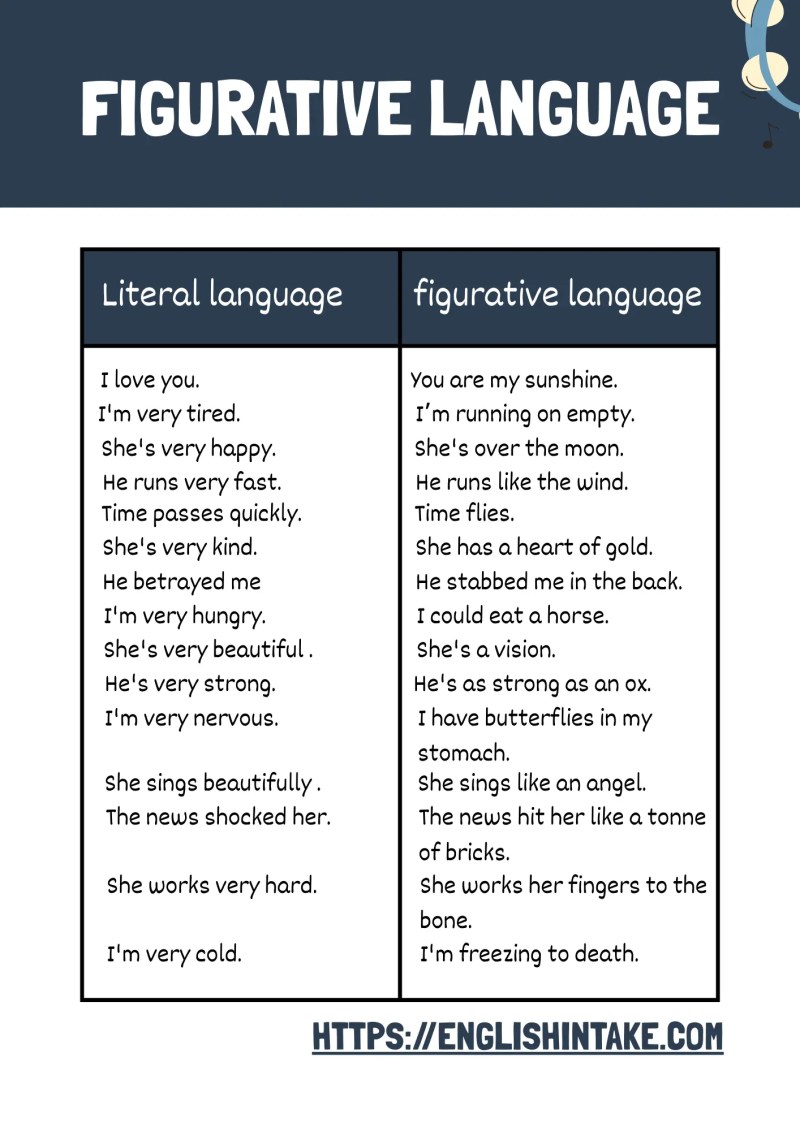
| Literal Language | Figurative Language |
|---|---|
| Direct, unambiguous meaning (e.g., "The temperature is 30°C"). | Indirect, layered meaning (e.g., "It’s hot enough to fry an egg on the sidewalk"). |
| Relies on dictionary definitions; low emotional charge. | Relies on context, culture, and subtext; high emotional charge. |
| Best for technical, legal, or scientific precision. | Best for storytelling, persuasion, and artistic expression. |
| Risk of miscommunication if audience lacks shared knowledge. | Risk of miscommunication if audience lacks cultural or contextual literacy. |
Future Trends and Innovations
As language evolves, so does the role of what is figurative language in digital spaces. Social media has democratized metaphor, with hashtags like #ThisIsWhatABlackGirlLooksLike using juxtaposition to challenge stereotypes. Meanwhile, AI-generated content—while often literal—is beginning to incorporate figurative language examples to sound more human. Tools like GPT-4 can now simulate poetic devices on demand, raising ethical questions about authenticity. In marketing, "experiential metaphors" (e.g., "Netflix and chill" for relaxation) are replacing static slogans, as brands seek to create immersive narratives.The future may also see figurative language integrated into data visualization. Infographics that describe trends as "peaks and valleys" or "tsunamis" of growth use spatial metaphors to simplify complex datasets. Neurolinguistic research could further unlock how to tailor metaphors to individual cognitive styles—imagine a sales pitch that adapts its figurative framing based on whether the listener is a visual, auditory, or kinesthetic thinker. One certainty: as language becomes more fragmented across dialects and digital slang, the ability to decode and wield figurative language will remain a cornerstone of effective communication.
Conclusion
The study of what is figurative language is not an academic exercise—it is a lens through which to understand human cognition. From the epics of Homer to the memes of TikTok, language’s power to transcend the literal has been its defining feature. Yet this power is not static; it adapts to cultural shifts, technological changes, and the ever-expanding frontiers of human thought. The next time you hear a politician call a policy "a lifeline" or a poet describe grief as "a room without walls," pause to consider: what is being said, and what is being felt beneath the words?Mastery of figurative language is not about memorizing tropes but about recognizing how language shapes reality. Whether you’re a writer, a leader, or simply a consumer of media, the ability to identify, analyze, and—when necessary—deploy these techniques will distinguish your communication. The words themselves may be old, but their potential is boundless.
Comprehensive FAQs
Q: What is figurative language, and how does it differ from literal language?
A: What is figurative language refers to expressions that use words beyond their standard definitions to create imagery, emotion, or emphasis. Unlike literal language (e.g., "The cat is on the mat"), figurative language relies on context and association (e.g., "Her voice was music to his ears"). The key difference is intent: literal language aims for precision, while figurative language prioritizes effect.
Q: Can you provide examples of figurative language in everyday speech?
A: Absolutely. Common figurative language examples include:
- Simile: "She’s as busy as a bee."
- Metaphor: "Time is a thief."
- Hyperbole: "I’ve told you a million times!"
- Personification: "The wind whispered through the trees."
- Idiom: "It’s raining cats and dogs."
Q: Why do some people struggle to understand figurative language?
A: Difficulty often stems from three factors:
- Cultural gaps: Metaphors rooted in specific traditions (e.g., "the elephant in the room") may confuse outsiders.
- Lack of context: Without shared knowledge (e.g., sports analogies for non-fans), figurative language loses impact.
- Cognitive load: Overusing complex tropes (e.g., dense allegory) can overwhelm listeners, especially in high-stakes settings like negotiations.
Q: How does figurative language work in non-English languages?
A: Figurative language is universal but culturally specific. For example:
- Japanese uses kenkyō (e.g., "the mountain is high" to imply a task is difficult).
- Arabic employs majas (rhetorical questions) to emphasize points.
- Spanish dicho (proverbs) often carry moral lessons (e.g., "Who sows the wind reaps the whirlwind").
Q: What are the risks of overusing figurative language?
A: While figurative language techniques enhance creativity, excess can:
- Create ambiguity (e.g., "the ball is in your court" may confuse those unfamiliar with sports).
- Undermine credibility (e.g., a CEO’s "we’re sailing into uncharted waters" might sound vague in a crisis).
- Alienate audiences (e.g., dense poetry in a technical manual).
Q: Can AI generate effective figurative language?
A: Current AI can mimic figurative language examples (e.g., generating metaphors or puns) but lacks true understanding. The output often feels generic (e.g., "the data was a treasure trove" instead of a fresh insight). Human writers excel at tailoring tropes to specific audiences, while AI struggles with context and emotional depth. However, AI-assisted tools can help brainstorm ideas or avoid clichés.
Q: How can I improve my ability to recognize figurative language?
A: Practice these strategies:
- Read widely: Poetry, classic literature, and even song lyrics expose you to diverse figurative language.
- Analyze media: Note how politicians, ads, and movies use metaphors to shape perception.
- Play with language: Try rewriting literal statements as similes or metaphors (e.g., "The project was slow" → "The project crawled like molasses").
- Study rhetoric: Books like The Elements of Style (Strunk & White) break down figurative devices.
- Engage in discussion: Ask others to explain their figurative language choices in conversations.
Leave a Comment
Comments are moderated before appearing. The data you submit is processed according to the Privacy Policy of Medicine.