Unseen Shield: What Does the Integumentary System Do?

The integumentary system is often dismissed as mere skin—a barrier between the self and the world. Yet beneath its surface lies a sophisticated network of organs, glands, and receptors that orchestrate survival, sensation, and identity. What does the integumentary system do? It is the body’s first line of defense, a sensory hub, and a dynamic regulator of temperature, immunity, and even psychological well-being. Without it, life as we know it would be impossible.
This system extends far beyond the epidermis. Hair, nails, sweat glands, and sebaceous secretions all play critical roles in maintaining homeostasis. A single disruption—whether from infection, environmental stress, or genetic anomalies—can trigger cascading effects across the body. Understanding its functions reveals why dermatologists and physiologists rank it among the most complex and resilient systems in human biology.
The integumentary system’s influence is silent yet profound. It communicates with the brain through touch, pain, and temperature signals, while simultaneously shielding internal organs from pathogens, UV radiation, and physical trauma. Its adaptability is unmatched: from the rapid dilation of blood vessels in heat to the thickening of the stratum corneum in chronic friction. What does the integumentary system do when pushed to its limits? It evolves, heals, and sometimes betrays the body’s fragility in diseases like psoriasis or melanoma.
The Complete Overview of the Integumentary System
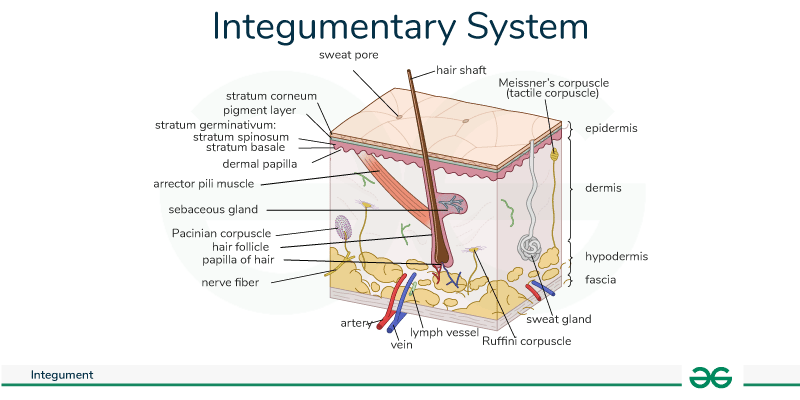
The integumentary system is a multi-layered organ system comprising the skin, accessory structures (hair, nails, glands), and associated tissues. It accounts for approximately 16% of total body weight and spans an average of 2 square meters in adults. Its primary functions—protection, sensation, thermoregulation, and metabolic regulation—are interdependent, creating a feedback loop that sustains life. What does the integumentary system do when these functions falter? The consequences range from minor irritation to systemic failure, underscoring its non-negotiable role in physiology.At its core, the system is stratified into three main layers: the epidermis (the outermost, keratinized barrier), the dermis (a dense connective tissue layer housing nerves and blood vessels), and the hypodermis (subcutaneous fat that insulates and cushions). Each layer contributes uniquely: the epidermis renews itself every 28–30 days, the dermis provides structural integrity, and the hypodermis stores energy while acting as a shock absorber. What does the integumentary system do when these layers interact? They create a symphony of protection, repair, and communication that defines human resilience.
Historical Background and Evolution
The study of the integumentary system traces back to ancient civilizations, where healers observed skin’s role in disease and injury. Egyptian papyri from 1550 BCE describe treatments for burns and infections, hinting at early recognition of the skin’s protective function. What does the integumentary system do in the context of survival? For early humans, its ability to tan (via melanin production) provided UV protection, while sweat glands allowed endurance in hot climates—a critical advantage in African savannas.Modern science refined this understanding in the 19th century, with advances in microscopy revealing the epidermis’s layered structure. The discovery of keratin’s role in waterproofing and the identification of Langerhans cells (immune sentinels) in the 1970s further cemented the system’s complexity. Evolutionarily, the integumentary system reflects adaptive pressures: hair loss in humans (compared to primates) optimized heat dissipation, while the development of eccrine glands enhanced thermoregulation. What does the integumentary system do when environmental demands change? It evolves, as seen in the thicker skin of desert-dwelling species or the melanin adaptations in high-altitude populations.
Core Mechanisms: How It Works
The integumentary system operates through a combination of passive and active processes. Passively, the stratum corneum acts as a physical barrier, preventing water loss and blocking pathogens via tight junctions between keratinocytes. Actively, the dermis houses mechanoreceptors (Meissner’s and Pacinian corpuscles) that translate physical stimuli into neural signals, while the hypodermis adjusts blood flow to regulate temperature. What does the integumentary system do when core temperature rises? Eccrine glands secrete sweat, which evaporates and cools the body—a process requiring energy expenditure and precise hormonal control.Table of Contents
- The Complete Overview of the Integumentary System
- Historical Background and Evolution
- Core Mechanisms: How It Works
- Key Benefits and Crucial Impact
- Major Advantages
- Comparative Analysis
- Future Trends and Innovations
- Conclusion
- Comprehensive FAQs
- Q: How does the integumentary system contribute to vitamin D production?
- Q: Can the integumentary system regenerate fully after severe damage?
- Q: Why does skin color vary among humans?
- Q: How do tattoos and piercings affect the integumentary system?
- Q: What role does the integumentary system play in aging?
- Q: Are there cultural differences in how the integumentary system is perceived?
- Q: Can the integumentary system influence mental health?
Beyond physical protection, the system participates in metabolic processes. Vitamin D synthesis begins when UVB radiation converts 7-dehydrocholesterol in the skin to previtamin D3. The system also plays a role in immune defense: dendritic cells in the epidermis present antigens to T-cells, initiating responses to infections. Disruptions in these mechanisms—such as impaired keratinization in ichthyosis or reduced melanin in vitiligo—highlight the system’s fragility. What does the integumentary system do when homeostasis is threatened? It activates compensatory responses, from inflammation to increased melanogenesis, to restore balance.
Key Benefits and Crucial Impact
The integumentary system’s contributions to health are foundational. It prevents dehydration by limiting transepidermal water loss, a process critical in arid environments where survival hinges on fluid retention. It also serves as a biological archive, with scars and pigmentation marking past injuries and exposures. What does the integumentary system do when exposed to chronic stress? It may develop conditions like acne or eczema, reflecting underlying physiological imbalances.Psychologically, the skin influences self-perception and social interactions. Touch, a primary sensory modality, releases oxytocin and reduces cortisol, linking the integumentary system to emotional well-being. Damage to this system—whether through burns or chronic diseases—can lead to psychological distress, isolating individuals from social and physical comforts.
"The skin is the largest organ of the body, but it is also the most exposed to the world—and the world’s responses." — Dr. Albert Kligman, Pioneering Dermatologist
Major Advantages
- Physical Protection: Blocks UV radiation (via melanin), pathogens (through antimicrobial peptides like cathelicidin), and mechanical damage (via keratinized layers).
- Thermoregulation: Sweat glands and vasodilation/constriction maintain core temperature within ±1°C of 37°C, preventing hypothermia or hyperthermia.
- Sensory Perception: 4–5 million nerve endings detect touch, pain, temperature, and pressure, enabling interaction with the environment.
- Immune Defense: Langerhans cells and sebaceous gland secretions (e.g., sebum) inhibit bacterial growth, while the skin’s acid mantle (pH 4–6) deters fungal infections.
- Metabolic Function: Synthesizes vitamin D, metabolizes drugs, and stores lipids in the hypodermis, influencing energy balance and hormone levels.

Comparative Analysis
| Function | Human Integumentary System | Non-Human Analogues |
|---|---|---|
| Primary Role | Protection, sensation, thermoregulation, vitamin D synthesis | Reptiles: Waterproof scales; Amphibians: Moist, permeable skin for gas exchange |
| Adaptive Mechanism | Sweat glands, melanin production, hair follicle cycling | Mammals: Fur thickness varies by climate; Birds: Uropygial glands secrete oils for feather maintenance |
| Vulnerability | Sunburn, infections (e.g., cellulitis), chronic diseases (e.g., psoriasis) | Insects: Exoskeleton limits flexibility; Fish: Mucus layer vulnerable to parasites |
| Evolutionary Trade-off | Loss of body hair for heat dissipation (vs. primates) | Armadillos: Armored carapace reduces mobility; Penguins: Thick blubber limits agility |
Future Trends and Innovations
Advances in biomaterials and regenerative medicine are redefining what the integumentary system can achieve. Artificial skin grafts, now used for burn victims, incorporate bioengineered epidermis and dermis to restore function and appearance. Research into melanocyte stem cells may soon offer cures for vitiligo, while wearable biosensors monitor skin health in real time, predicting conditions like diabetes through glucose levels in interstitial fluid.The intersection of dermatology and AI is another frontier. Machine learning algorithms analyze dermatoscopic images to detect skin cancer with 95% accuracy, addressing delays in diagnosis. What does the integumentary system do in this digital age? It becomes a canvas for innovation, from smart textiles that regulate temperature to gene-editing tools like CRISPR correcting genetic skin disorders. The future may even see "programmable skin"—engineered tissues that respond to environmental cues with tailored biological functions.
Conclusion
The integumentary system is far more than a passive covering; it is a dynamic, adaptive network that defines human existence. What does the integumentary system do when challenged? It reveals the body’s capacity for repair, adaptation, and resilience. From the microscopic battles of Langerhans cells to the macroscopic healing of a wound, its functions are a testament to nature’s precision.Yet its fragility demands respect. Pollution, UV exposure, and lifestyle factors erode its integrity, leading to conditions that affect not just the skin but overall health. Understanding its mechanisms empowers individuals to protect this vital system—through sun protection, hydration, and early medical intervention. The integumentary system does not act alone; it is a partner in health, a mirror of our internal and external worlds.
Comprehensive FAQs
Q: How does the integumentary system contribute to vitamin D production?
A: When UVB rays penetrate the epidermis, they convert 7-dehydrocholesterol in keratinocytes into previtamin D3, which is then hydroxylated in the liver and kidneys to form active vitamin D (calcitriol). This process is critical for calcium absorption and bone health.
Q: Can the integumentary system regenerate fully after severe damage?
A: Partial regeneration is possible, but severe burns or chronic wounds may leave scars due to fibrosis (excess collagen deposition). Stem cells in the hair follicles and basal layer of the epidermis aid repair, but full restoration of appendages (e.g., sweat glands) is limited.
Q: Why does skin color vary among humans?
A: Melanin production varies due to genetic adaptations to UV exposure. Darker skin has more eumelanin, which protects against UV-induced DNA damage, while lighter skin allows sufficient vitamin D synthesis in low-sun regions. This diversity reflects evolutionary trade-offs between protection and nutrition.
Q: How do tattoos and piercings affect the integumentary system?
A: Tattoos involve depositing pigment into the dermis, triggering a foreign-body response and potential inflammation. Piercings breach the skin’s barrier, increasing infection risk (e.g., Staphylococcus) and potentially causing keloid formation in prone individuals.
Q: What role does the integumentary system play in aging?
A: Aging reduces epidermal thickness, collagen production, and sebum secretion, leading to dryness, wrinkles, and impaired wound healing. Diminished melanocyte activity also causes age spots, while slower cell turnover increases susceptibility to skin cancer.
Q: Are there cultural differences in how the integumentary system is perceived?
A: Yes. In many Eastern cultures, pale skin is associated with wealth (historically linked to indoor lifestyles), while in Western societies, tanned skin has been tied to leisure and health. These perceptions influence cosmetic practices, from skin-lightening creams to tanning beds.
Q: Can the integumentary system influence mental health?
A: Absolutely. Skin conditions like eczema or acne can trigger anxiety and depression due to stigma or discomfort. Conversely, touch therapy (e.g., massage) releases oxytocin, reducing stress. The skin’s role in social bonding and self-esteem underscores its psychological significance.
Leave a Comment
Comments are moderated before appearing. The data you submit is processed according to the Privacy Policy of Medicine.