The Hidden Truth: How Many Ribs Does a Human Have?
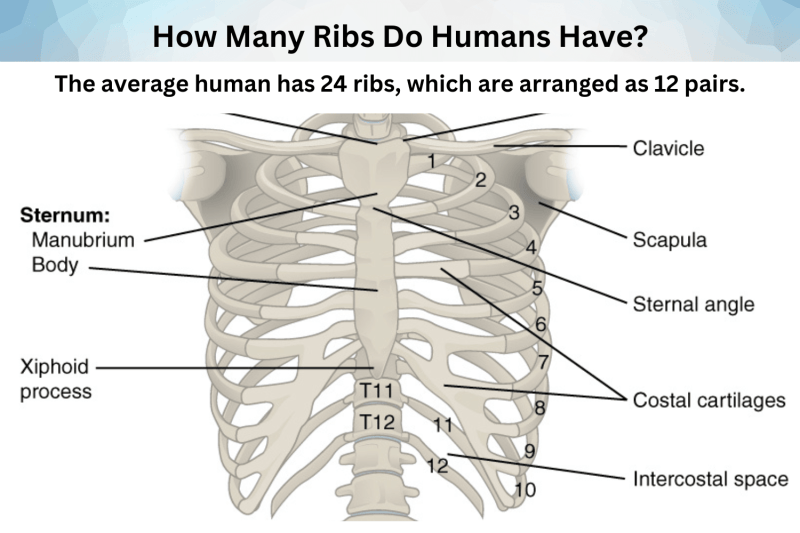
The rib cage is one of the most resilient yet misunderstood structures in the human body. Most people assume the answer to how many ribs does a human have is straightforward—a number etched into school textbooks. Yet, beneath that assumption lies a fascinating interplay of biology, evolution, and medical precision. The truth is far more nuanced than a simple count. Ribs don’t just protect vital organs; they’re a living archive of our evolutionary past, a framework for respiration, and a silent participant in nearly every movement we make. Even the most seasoned anatomists might pause when asked how many ribs a human actually possesses—because the answer isn’t as fixed as it seems.
At first glance, the rib cage appears uniform, a symmetrical cage of bones encasing the thoracic cavity. But dig deeper, and the variations emerge. Some ribs are floating, others are fused, and a handful of people are born with extra or missing ones—a natural deviation that challenges the textbook answer. These anomalies aren’t just medical oddities; they’re reminders that the human body is a dynamic, adaptive system, not a rigid blueprint. The question how many ribs does a human have becomes a gateway to understanding how form follows function, how evolution leaves its fingerprints on our bones, and why even the simplest anatomical queries can lead to profound revelations.
Medical textbooks often simplify the answer to how many ribs does a human have as 24—12 pairs—yet this oversimplification glosses over critical details. The reality is more fluid. Ribs aren’t static; they’re influenced by genetics, trauma, and even the wear and tear of daily life. Some individuals may have 11 pairs, while others might possess 13 or more, a condition known as thoracic rib anomalies. These variations aren’t just numbers; they’re clues to how our ancestors adapted to environmental pressures, how modern medicine interprets X-rays, and why surgical procedures must account for individual differences. The rib cage, it turns out, is far more than a protective shell—it’s a story written in bone.
The Complete Overview of How Many Ribs Does a Human Have
The human rib cage is a masterpiece of structural engineering, designed to balance protection, mobility, and efficiency. When posed with how many ribs does a human have, most sources cite 24 ribs—12 pairs—arranged in a curved, protective arch around the thoracic cavity. This number is derived from the standard anatomical model, where the first seven pairs (true ribs) attach directly to the sternum via costal cartilages, the next three pairs (false ribs) connect indirectly, and the final two pairs (floating ribs) terminate in the abdominal musculature without sternal attachment. However, this "standard" model is an average, not a universal truth. The actual count can vary due to genetic, developmental, or pathological factors, making the question how many ribs does a human have far more complex than it appears.Anatomists classify ribs based on their structural and functional roles, but these classifications are not absolute. For instance, the floating ribs—the 11th and 12th pairs—are called "floating" because their anterior ends are free, not fused to the sternum. Yet, in some individuals, these ribs may be partially fused or exhibit atypical curvature, further complicating the answer to how many ribs does a human have. Additionally, ribs are not isolated bones; they articulate with vertebrae, the sternum, and each other through complex joints, allowing for the flexibility needed during breathing, coughing, or even laughing. This interconnectedness means that variations in one rib can influence the structure of others, creating a domino effect that underscores the body’s adaptive nature.
Historical Background and Evolution
The evolution of ribs offers a window into the broader story of vertebrate development. Early tetrapods—our four-limbed ancestors—developed ribs as an adaptation to support a more rigid body structure, transitioning from aquatic to terrestrial life. These primitive ribs were simpler, serving primarily as protective plates for the lungs and heart. Over millions of years, as mammals evolved, ribs became more specialized, expanding in number and complexity to accommodate larger bodies, more efficient respiration, and the demands of upright posture. The question how many ribs does a human have today reflects this evolutionary journey, where each rib tells a story of survival, adaptation, and the pressures of natural selection.Fossil records and comparative anatomy reveal that the number of ribs in early mammals varied widely. Some prehistoric species had as few as 10 pairs, while others possessed 14 or more. Humans, like most modern mammals, settled on 12 pairs, but this isn’t a fixed rule. Genetic studies suggest that the number of ribs is influenced by HOX genes, which regulate embryonic development. Mutations in these genes can lead to rib anomalies, such as cervical ribs (extra ribs near the neck) or lumbar ribs (additional ribs near the lower back). These variations aren’t just historical artifacts; they persist in modern populations, proving that the answer to how many ribs does a human have is still evolving.
Core Mechanisms: How It Works
The rib cage’s functionality is a symphony of biomechanics, where each rib plays a unique role in respiration, posture, and organ protection. During inhalation, the diaphragm contracts, increasing thoracic volume, while the external intercostal muscles elevate the ribs, expanding the chest cavity. This movement creates a vacuum that pulls air into the lungs—a process where the ribs act as levers, their curvature and articulation with vertebrae allowing for efficient expansion. The answer to how many ribs does a human have isn’t just about count; it’s about how these bones work in unison to facilitate one of the body’s most critical functions: breathing.Table of Contents
- The Complete Overview of How Many Ribs Does a Human Have
- Historical Background and Evolution
- Core Mechanisms: How It Works
- Key Benefits and Crucial Impact
- Major Advantages
- Comparative Analysis
- Future Trends and Innovations
- Conclusion
- Comprehensive FAQs
- Q: Why do some people have more or fewer ribs than the standard 24?
- Q: Can the number of ribs change over a person’s lifetime?
- Q: Do ribs affect breathing capacity?
- Q: Are there cultural or historical references to rib count in medicine or mythology?
- Q: How do rib variations impact surgical procedures?
- Q: Can exercise or posture training change the appearance or function of ribs?
- Q: Are there animals with ribs similar to humans?
- Q: What medical conditions are linked to abnormal rib counts?
- Q: How do ribs contribute to pain in conditions like costochondritis?
- Q: Can rib injuries heal without medical treatment?
Ribs also serve as attachment points for muscles, including the serratus anterior, pectoralis minor, and latissimus dorsi, which contribute to upper body strength and movement. The floating ribs, in particular, play a role in stabilizing the lower thoracic cavity and protecting organs like the kidneys and spleen. Their mobility is crucial during activities like coughing or vomiting, where abdominal pressure must be managed without compromising the integrity of the rib cage. Even the smallest deviation in rib structure—such as an extra pair or a fused segment—can alter muscle attachment points, potentially affecting posture, breathing efficiency, or even pain perception. This interconnectedness highlights why the question how many ribs does a human have is inseparable from its functional implications.
Key Benefits and Crucial Impact
The rib cage is often overlooked in discussions about human anatomy, yet its impact is profound. Beyond its protective role, the rib cage influences respiratory capacity, core stability, and even emotional expression. A well-structured rib cage allows for deeper breaths, better oxygenation, and reduced risk of conditions like chronic obstructive pulmonary disease (COPD). Conversely, rib anomalies—such as those addressed by how many ribs does a human have—can lead to complications like restricted lung expansion, nerve compression, or postural imbalances. The rib cage is also a silent participant in trauma; fractures or dislocations can have cascading effects on the thoracic organs, making rib integrity a critical factor in survival.The rib cage’s design reflects a delicate balance between rigidity and flexibility. Too few ribs might leave vital organs vulnerable, while too many could restrict movement. The human answer to how many ribs does a human have—typically 24—strikes this equilibrium, but individual variations remind us that biology is not one-size-fits-all. Even minor deviations can have significant implications, from athletic performance to surgical planning. Understanding these nuances is essential for medical professionals, athletes, and anyone interested in the intricate workings of the human body.
"Ribs are not mere bones; they are the body’s silent guardians, shaping our ability to breathe, move, and endure. Their structure is a testament to evolution’s precision—and its occasional surprises."
— Dr. Eleanor Voss, Anatomist and Evolutionary Biologist
Major Advantages
- Protective Shield: The rib cage encases the heart, lungs, and major blood vessels, absorbing impact and reducing injury risk during trauma.
- Respiratory Efficiency: The curvature and articulation of ribs optimize lung expansion, ensuring efficient oxygen exchange during inhalation and exhalation.
- Postural Support: Ribs serve as attachment points for core and back muscles, contributing to spinal alignment and reducing the risk of chronic pain.
- Muscle Functionality: The rib cage’s structure enables a wide range of upper body movements, from lifting to throwing, by providing stable leverage for muscles.
- Adaptive Resilience: Variations in rib count or structure (as seen in answers to how many ribs does a human have) highlight the body’s ability to compensate for anomalies, often without functional impairment.

Comparative Analysis
| Feature | Human Rib Cage | Key Differences in Other Species |
|---|---|---|
| Typical Rib Count | 12 pairs (24 ribs total) | Cats: 13 pairs; Dogs: 13-14 pairs; Snakes: 200+ ribs (vertebrae-based); Birds: 5-7 pairs (fused into a rigid structure). |
| Functional Role | Protection, respiration, muscle attachment | Birds: Primarily for flight muscle attachment; Reptiles: Often segmented for flexibility; Whales: Reduced ribs for streamlined swimming. |
| Structural Variations | Floating ribs, cervical/lumbar anomalies | Crocodiles: Gastric ribs (aid digestion); Armadillos: Extra ribs for armor-like protection. |
| Evolutionary Origin | Derived from tetrapod ancestors | Fish: Ribs evolved from fin supports; Amphibians: Simpler, less rigid structures. |
Future Trends and Innovations
Advances in medical imaging and genetic research are reshaping our understanding of how many ribs does a human have and why variations occur. Techniques like 3D printing of patient-specific rib models are already being used to improve surgical precision, particularly in cases of rib anomalies or trauma. Future innovations may include bioengineered rib replacements for individuals born with congenital defects, or even rib cages designed to enhance respiratory function in patients with chronic illnesses. Additionally, CRISPR and other gene-editing tools could one day allow for the correction of genetic mutations that lead to atypical rib counts, potentially eliminating conditions like polyspondylia (extra ribs).The field of biomechanics is also poised to uncover new insights into rib function. Wearable sensors and AI-driven motion analysis could reveal how rib structure influences athletic performance, from marathon runners to weightlifters. As our understanding of the rib cage deepens, the answer to how many ribs does a human have may evolve from a static number to a dynamic metric—one that reflects not just anatomy, but also individual health, lifestyle, and even environmental adaptations. The future of rib research lies at the intersection of medicine, technology, and evolutionary biology, promising discoveries that could redefine how we perceive this often-overlooked part of the human body.

Conclusion
The question how many ribs does a human have is deceptively simple, yet it opens a door to a world of anatomical complexity, evolutionary history, and medical intrigue. What begins as a curiosity about bone count quickly unfolds into a study of resilience, adaptation, and the body’s remarkable ability to defy rigid definitions. From the floating ribs that hint at our primitive past to the genetic quirks that make each person’s rib cage unique, this structure is far more than a cage—it’s a living testament to the interplay between form and function.As science continues to probe the mysteries of the rib cage, the answer to how many ribs does a human have may no longer be confined to a single number. Instead, it could become a personalized metric, shaped by genetics, environment, and even the choices we make every day. Whether through medical breakthroughs, athletic training, or simply the wonder of human diversity, the rib cage remains a cornerstone of our biological identity—one that deserves far more attention than it often receives.
Comprehensive FAQs
Q: Why do some people have more or fewer ribs than the standard 24?
A: Variations in rib count—such as 11 or 13 pairs—are typically due to genetic mutations affecting HOX genes, which regulate embryonic development. These anomalies are usually harmless but can influence muscle attachment or organ positioning. Conditions like polyspondylia (extra ribs) or hemivertebrae (missing ribs) may require medical evaluation if they cause pain or functional issues.
Q: Can the number of ribs change over a person’s lifetime?
A: No, the number of ribs a person is born with remains constant throughout life. However, ribs can fracture, fuse, or degenerate due to age, trauma, or conditions like osteoporosis. Surgical procedures (e.g., rib resection) may also alter rib structure temporarily, but the total count does not increase or decrease.
Q: Do ribs affect breathing capacity?
A: Absolutely. The mobility and structure of ribs directly impact lung expansion. Conditions like kyphosis (rounded spine) or rib fractures can restrict breathing, while strong, flexible ribs (as in athletes) enhance respiratory efficiency. Even minor rib anomalies can influence diaphragm movement, affecting oxygen intake.
Q: Are there cultural or historical references to rib count in medicine or mythology?
A: Yes. In ancient Egyptian medicine, the rib cage was associated with the heart and breath of life. Some cultures interpreted rib anomalies as omens, while medieval anatomists debated whether the number of ribs correlated with lifespan. Modern medicine uses rib count as a diagnostic tool, particularly in imaging studies for trauma or congenital defects.
Q: How do rib variations impact surgical procedures?
A: Surgeons must account for rib anomalies during thoracic surgeries (e.g., heart or lung operations). Extra ribs may require additional incisions, while fused or missing ribs can alter anatomical landmarks. Preoperative imaging (CT/MRI) is critical to planning, as deviations from the standard how many ribs does a human have can complicate procedures.
Q: Can exercise or posture training change the appearance or function of ribs?
A: While exercise cannot alter rib count or bone structure, it can improve rib mobility and muscle attachment. Posture correction (e.g., for rounded shoulders) may enhance rib cage expansion, while strength training can reinforce rib-associated muscles. However, structural changes—like correcting scoliosis—require medical intervention.
Q: Are there animals with ribs similar to humans?
A: Most mammals share a similar rib structure, but variations exist. For example, snakes have hundreds of ribs (attached to vertebrae), while birds have fewer, fused ribs to support flight. Reptiles and amphibians often have simpler rib cages, reflecting their evolutionary paths. Comparative anatomy helps scientists trace the origins of human rib structure.
Q: What medical conditions are linked to abnormal rib counts?
A: Conditions like Jarcho-Levin syndrome (fused ribs) or cleidocranial dysplasia (missing clavicles and ribs) can arise from genetic mutations. Rib anomalies may also accompany syndromes like Down syndrome or Marfan syndrome. While many variations are asymptomatic, severe cases can lead to respiratory or postural issues requiring intervention.
Q: How do ribs contribute to pain in conditions like costochondritis?
A: Costochondritis involves inflammation of the cartilage where ribs meet the sternum, causing sharp chest pain. Unlike heart-related pain, it’s often exacerbated by movement or pressure. Rib anomalies or trauma can predispose individuals to this condition, highlighting how rib structure influences pain perception.
Q: Can rib injuries heal without medical treatment?
A: Minor rib fractures (without lung or organ damage) often heal with rest, ice, and over-the-counter pain relief. However, severe fractures, displaced ribs, or multiple breaks may require medical intervention (e.g., surgery) to prevent complications like pneumothorax. Always consult a healthcare provider for persistent pain or breathing difficulties.
Leave a Comment
Comments are moderated before appearing. The data you submit is processed according to the Privacy Policy of Medicine.