What Is Difference Between Prokaryotes and Eukaryotes? The Cellular Blueprint of Life

The first cells to emerge on Earth were simple, yet their legacy persists in every organism alive today. Prokaryotes—bacteria and archaea—dominated the planet for billions of years before eukaryotes, with their complex internal structures, evolved. The what is difference between prokaryotes and eukaryotes question cuts to the heart of biology: how life organizes itself at the microscopic level. These distinctions aren’t just academic; they shape antibiotic resistance, genetic engineering, and even our understanding of diseases like malaria or tuberculosis.
At their core, prokaryotes and eukaryotes represent two fundamentally different solutions to the same problem: how to package DNA, generate energy, and replicate efficiently. One lacks a nucleus; the other compartmentalizes its functions into specialized organelles. One thrives in extreme environments; the other powers multicellular life. The difference between prokaryotes and eukaryotes isn’t just about size or shape—it’s about evolutionary trade-offs that define which organisms can survive where, and how they interact with each other.
Understanding these differences is critical. Prokaryotes outnumber eukaryotes by orders of magnitude, yet their simplicity belies their complexity. Eukaryotes, though rarer, enable everything from mushrooms to humans. The key distinctions between prokaryotic and eukaryotic cells reveal why some pathogens evade treatments, why mitochondria are relics of ancient bacteria, and why CRISPR’s precision editing relies on bacterial machinery.
The Complete Overview of What Is Difference Between Prokaryotes and Eukaryotes
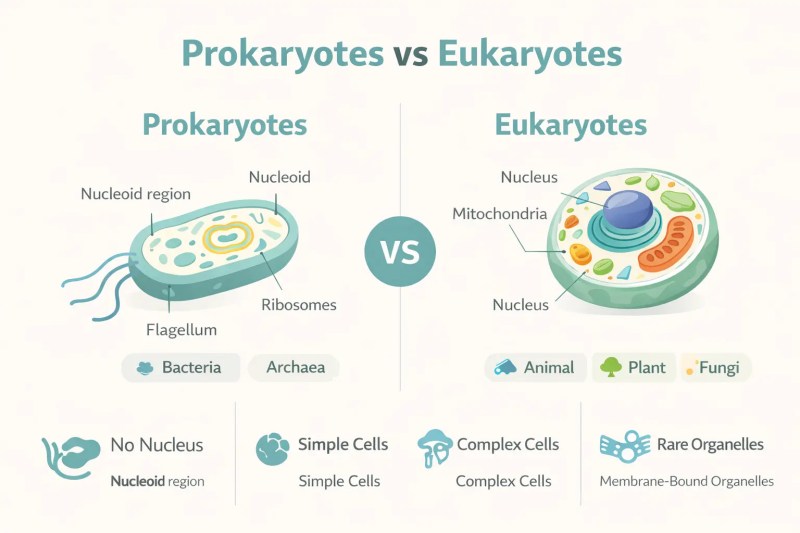
The what is difference between prokaryotes and eukaryotes debate hinges on three pillars: genetic organization, cellular architecture, and metabolic diversity. Prokaryotes—lacking a defined nucleus—store their DNA in a nucleoid region, often as a single circular chromosome with minimal associated proteins. Their cytoplasm is undivided, save for ribosomes and inclusion bodies. Eukaryotes, by contrast, enclose their DNA within a double-membrane nucleus, surrounded by a cytoskeleton that orchestrates intracellular transport. This structural divergence isn’t arbitrary; it reflects evolutionary pressures. Prokaryotes prioritize rapid reproduction and adaptability, while eukaryotes invest in specialization, enabling tissues, organs, and the intricate signaling networks of animals and plants.The difference between prokaryotes and eukaryotes extends beyond static anatomy to dynamic processes. Prokaryotic cells divide via binary fission, a streamlined process without mitosis or meiosis. Eukaryotes, however, undergo complex cell cycles with checkpoints, ensuring genetic fidelity. Their mitochondria—descendants of engulfed prokaryotes—retain their own DNA, a fossil record of endosymbiosis. Even their ribosomes differ: prokaryotic 70S ribosomes are the target of antibiotics like tetracycline, while eukaryotic 80S ribosomes are spared, explaining why these drugs don’t harm human cells.
Historical Background and Evolution
The what is difference between prokaryotes and eukaryotes story begins nearly 4 billion years ago, when the first cells arose in a primordial soup. Prokaryotes—likely ancestors of modern bacteria and archaea—were Earth’s sole inhabitants for over 2 billion years. Their dominance stemmed from efficiency: no energy wasted on complex structures, just rapid replication and metabolic versatility. Fossilized stromatolites, layered microbial mats from Australia’s Pilbara region, offer the earliest evidence of prokaryotic life, dating back to 3.5 billion years ago. These organisms thrived in anoxic environments, laying the foundation for Earth’s oxygenated atmosphere through cyanobacterial photosynthesis.The transition to eukaryotes remains one of biology’s great mysteries. The leading theory, endosymbiosis, proposes that a larger prokaryote engulfed an oxygen-using bacterium (the future mitochondrion) and a photosynthetic cyanobacterium (the chloroplast’s ancestor). Genetic evidence supports this: mitochondrial DNA is distinct from nuclear DNA, and its genes resemble those of modern alpha-proteobacteria. The difference between prokaryotes and eukaryotes thus reflects a symbiotic merger, where prokaryotic simplicity gave rise to eukaryotic complexity. This event, roughly 1.5–2 billion years ago, enabled multicellularity and, ultimately, the Cambrian explosion of animal diversity.
Core Mechanisms: How It Works
The what is difference between prokaryotes and eukaryotes question becomes clearer when examining their operational mechanics. Prokaryotic cells rely on direct diffusion for molecular transport, given their small size (typically 0.1–5 µm). Their plasma membrane folds into mesosomes, increasing surface area for ATP production, while plasmids—small, extrachromosomal DNA molecules—allow horizontal gene transfer, a key driver of antibiotic resistance. Eukaryotes, with diameters up to 100 µm, solve the diffusion problem with compartmentalization: the endoplasmic reticulum, Golgi apparatus, and lysosomes create specialized microenvironments for protein synthesis, lipid processing, and waste degradation.Table of Contents
- The Complete Overview of What Is Difference Between Prokaryotes and Eukaryotes
- Historical Background and Evolution
- Core Mechanisms: How It Works
- Key Benefits and Crucial Impact
- Major Advantages
- Comparative Analysis
- Future Trends and Innovations
- Conclusion
- Comprehensive FAQs
- Q: Can prokaryotes and eukaryotes coexist within the same organism?
- Q: Why don’t antibiotics work on eukaryotic cells?
- Q: Are there any eukaryotes without mitochondria?
- Q: How do prokaryotes reproduce without sex?
- Q: Could a prokaryote ever evolve into a eukaryote?
- Q: What’s the smallest known eukaryote?
- Q: How do prokaryotes contribute to human health beyond pathogens?
- Q: Are there eukaryotes that don’t divide by mitosis?
- Q: Can a eukaryote survive without a nucleus?
- Q: How do scientists study prokaryotes and eukaryotes that can’t be cultured?
Energy metabolism further illustrates the difference between prokaryotes and eukaryotes. Prokaryotes employ diverse pathways: some ferment sugars anaerobically, others perform aerobic respiration using plasma membrane invaginations. Eukaryotes, with their mitochondria, achieve higher ATP yields via oxidative phosphorylation, but this comes at the cost of greater structural investment. The evolutionary trade-off is stark: prokaryotes excel in unstable environments where flexibility is paramount, while eukaryotes dominate stable niches where specialization confers advantages.
Key Benefits and Crucial Impact
The what is difference between prokaryotes and eukaryotes divide isn’t just theoretical—it underpins modern medicine, biotechnology, and ecology. Prokaryotes, as Earth’s most abundant lifeforms, drive nutrient cycling, decompose organic matter, and even influence climate through methane production. Their genetic plasticity enables rapid adaptation, making them ideal for bioremediation (e.g., oil-spill cleanup) and biofuel production. Eukaryotes, meanwhile, power agriculture (plants), immunology (white blood cells), and neuroscience (neurons). The difference between prokaryotic and eukaryotic cells thus translates to practical applications: antibiotics target prokaryotic ribosomes, while eukaryotic cell culture is essential for vaccine development.The impact of these cellular differences extends to global health. Pathogenic prokaryotes like Mycobacterium tuberculosis evade treatments by forming biofilms and persister cells, exploiting their simple genetic organization. Eukaryotic parasites such as Plasmodium (malaria) hijack host cell machinery, making them harder to eradicate. Understanding these distinctions allows scientists to design targeted therapies—e.g., artemisinin disrupts Plasmodium’s organelle functions without harming human cells.
"The prokaryote-eukaryote divide is more than a biological curiosity; it’s the scaffold upon which all life is built. Mastering their differences unlocks solutions to some of humanity’s greatest challenges—from antibiotic resistance to sustainable energy." — Dr. Lynn Margulis, Evolutionary Biologist
Major Advantages
The what is difference between prokaryotes and eukaryotes comparison reveals distinct evolutionary advantages:-
Prokaryotic Advantages:
- Rapid Replication: Binary fission allows doubling in 20–30 minutes under ideal conditions (e.g., E. coli).
- Genetic Flexibility: Horizontal gene transfer enables quick adaptation to antibiotics or environmental changes.
- Metabolic Diversity: Can thrive in extreme conditions (e.g., Thermus aquaticus in hot springs, Deinococcus radiodurans in radiation).
- Low Maintenance: No energy spent on complex structures; ideal for resource-scarce environments.
- Symbiotic Potential: Prokaryotes form mutualistic relationships (e.g., gut microbiota in humans, nitrogen-fixing bacteria in legumes).
-
Eukaryotic Advantages:
- Specialization: Organelles allow division of labor (e.g., mitochondria for energy, lysosomes for digestion).
- Genetic Stability: Mitosis and meiosis reduce mutation rates, enabling complex genomes (e.g., human ~3 billion base pairs).
- Multicellularity: Cell signaling and adhesion enable tissues, organs, and organisms with diverse functions.
- Energy Efficiency: Mitochondria maximize ATP production, supporting high-energy processes (e.g., muscle contraction, neural transmission).
- Immune Complexity: Eukaryotes develop adaptive immunity (e.g., antibodies in vertebrates), allowing targeted pathogen defense.
Comparative Analysis
The difference between prokaryotes and eukaryotes can be distilled into a few key structural and functional contrasts:| Feature | Prokaryotes | Eukaryotes |
|---|---|---|
| Nuclear Organization | No true nucleus; DNA in nucleoid region (circular, no histones). | DNA enclosed in double-membrane nucleus (linear chromosomes with histones). |
| Cell Size | 0.1–5 µm (smaller surface-area-to-volume ratio). | 10–100 µm (larger, with internal membranes). |
| Organelles | None (except ribosomes and, in some, thylakoids). | Mitochondria, ER, Golgi, lysosomes, etc. |
| Reproduction | Binary fission (no mitosis/meiosis). | Mitosis (asexual) or meiosis (sexual reproduction). |
Future Trends and Innovations
Advances in synthetic biology are blurring the what is difference between prokaryotes and eukaryotes line. Researchers are engineering minimal cells—stripped-down prokaryote-like organisms with eukaryotic features—to study the origins of complexity. CRISPR-based gene drives could manipulate prokaryotic populations to combat antibiotic resistance, while eukaryotic cell engineering (e.g., CAR-T therapy) is revolutionizing cancer treatment. The future of prokaryote-eukaryote research may lie in hybrid systems: for instance, bacterial artificial chromosomes (BACs) are used to study eukaryotic genes in prokaryotic hosts.Climate change will further test the difference between prokaryotes and eukaryotes. Prokaryotes, as primary decomposers, will play a critical role in carbon cycling, but their metabolic byproducts (e.g., methane) may accelerate warming. Eukaryotic plants, under stress, could rely on symbiotic prokaryotes (e.g., mycorrhizal fungi) for survival. Understanding these interactions will be key to developing resilient ecosystems.

Conclusion
The what is difference between prokaryotes and eukaryotes question is foundational to biology, yet its answers are constantly evolving. What once seemed like rigid categories now appear as a spectrum, with archaea bridging prokaryotic and eukaryotic traits. The distinction between these cell types isn’t just about classification—it’s about unraveling the rules of life itself. From the bacterial factories producing insulin to the eukaryotic cells in your brain firing electrical signals, every organism exploits these fundamental differences to thrive.As technology advances, the gap between prokaryotes and eukaryotes may narrow further. Synthetic cells, gene-editing tools, and ecological engineering will force us to rethink these categories. But one truth remains: the difference between prokaryotes and eukaryotes is the difference between simplicity and complexity, between survival and specialization—and it’s the bedrock upon which all life is built.
Comprehensive FAQs
Q: Can prokaryotes and eukaryotes coexist within the same organism?
A: Yes. Humans host trillions of prokaryotes (gut microbiota), and eukaryotic cells contain prokaryote-derived organelles (mitochondria and chloroplasts). Some parasites, like Wolbachia bacteria, live inside eukaryotic host cells, manipulating their reproduction.
Q: Why don’t antibiotics work on eukaryotic cells?
A: Most antibiotics exploit prokaryotic-specific structures (e.g., peptidoglycan cell walls, 70S ribosomes). Eukaryotic cells lack these targets, though some drugs (e.g., amphotericin B) target fungal cell membranes, which differ from animal cells.
Q: Are there any eukaryotes without mitochondria?
A: Yes. Some parasites (e.g., Giardia lamblia) and microsporidia have lost mitochondria secondarily. Others, like Entamoeba, have highly reduced "mitosomes" that perform only a few mitochondrial functions.
Q: How do prokaryotes reproduce without sex?
A: While prokaryotes lack meiosis, they use horizontal gene transfer (conjugation, transformation, transduction) to acquire genetic diversity. This process allows bacteria to share antibiotic resistance genes or metabolic pathways rapidly.
Q: Could a prokaryote ever evolve into a eukaryote?
A: Unlikely naturally, but synthetic biology experiments attempt to recreate endosymbiosis. For example, researchers have engineered bacteria to engulf other cells, mimicking the steps that may have led to mitochondria.
Q: What’s the smallest known eukaryote?
A: Microsporidia (e.g., Encephalitozoon cuniculi) are among the smallest eukaryotes, with cells as small as 1–4 µm. They lack mitochondria but retain eukaryotic features like a nucleus and spindle poles.
Q: How do prokaryotes contribute to human health beyond pathogens?
A: Prokaryotes produce vitamins (e.g., K and B12 in the gut), ferment foods (yogurt, cheese), and degrade pollutants. They’re also used in biopharming (e.g., E. coli producing insulin) and bioremediation (e.g., Pseudomonas breaking down oil spills).
Q: Are there eukaryotes that don’t divide by mitosis?
A: Some eukaryotes use alternative division mechanisms. For example, Plasmodium (malaria parasite) undergoes schizogony—multiple nuclear divisions without cytokinesis—creating a multinucleate cell. Fungi like Aspergillus form conidia via asexual budding.
Q: Can a eukaryote survive without a nucleus?
A: No. The nucleus is essential for DNA protection, replication, and gene regulation. However, some eukaryotes (e.g., Malaria parasites during certain stages) temporarily lose nuclear membranes, but this is transient and non-viable long-term.
Q: How do scientists study prokaryotes and eukaryotes that can’t be cultured?
A: Metagenomics sequences environmental DNA directly, revealing uncultured microbes. Single-cell genomics and CRISPR-based tools (e.g., Cas9 labeling) allow analysis of individual cells without cultivation. For eukaryotes, techniques like RNA-seq and fluorescent in situ hybridization (FISH) bypass culturing.
Leave a Comment
Comments are moderated before appearing. The data you submit is processed according to the Privacy Policy of Medicine.