How Many Americans Speak Spanish? The Exact Percentage & Why It Matters
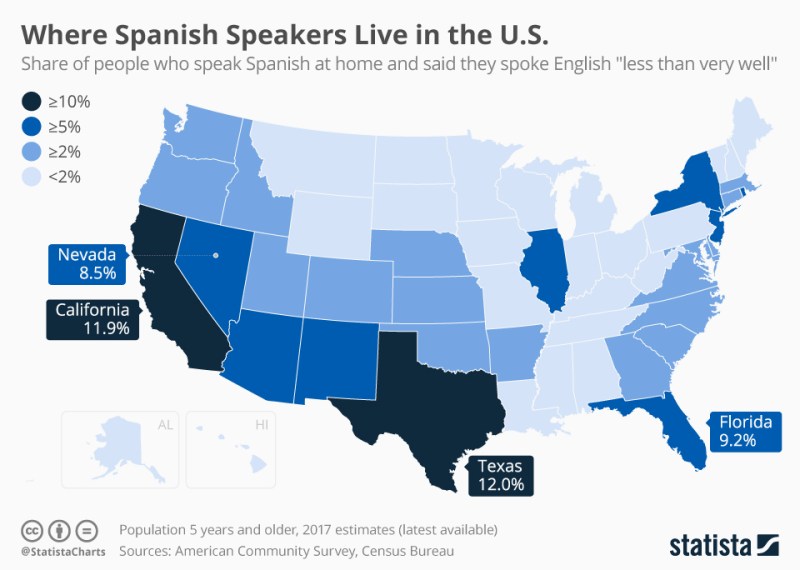
The U.S. Census Bureau’s latest estimates reveal that 12.1% of Americans over age 5 speak Spanish at home, a figure that climbs to 14.3% when including all ages. But these numbers mask deeper realities: Spanish is now the second most spoken language in 29 states, and in places like New Mexico, it surpasses English as the dominant home language. The question of what percentage of Americans speak Spanish isn’t just about demographics—it’s about economic influence, political power, and cultural identity.
Behind these statistics lies a century of migration, assimilation, and linguistic evolution. From the Spanish colonial era to the mass waves of Latin American immigration in the 20th century, Spanish has woven itself into the fabric of American life. Yet the growth isn’t uniform. While Florida and Texas see Spanish usage soar, rural Midwest communities remain overwhelmingly English-dominant. The disparity raises critical questions: Is Spanish becoming a true national language, or will it remain a regional force?
The implications stretch beyond language. Bilingualism boosts wages, bridges cultural divides, and even influences consumer markets. Companies from Walmart to Netflix now tailor content for Spanish speakers, while schools grapple with funding for dual-language programs. Understanding what percentage of Americans speak Spanish isn’t just academic—it’s a lens into America’s future.
The Complete Overview of What Percentage of Americans Speak Spanish
The most cited benchmark comes from the 2022 American Community Survey (ACS), which reports that 12.1% of the U.S. population aged 5 and older speaks Spanish at home. When expanded to all age groups, the figure rises to 14.3%, reflecting the younger, fast-growing Hispanic demographic. However, these numbers understate the full picture. Only 4.8% of Americans are proficient in Spanish as a second language, per the U.S. English Proficiency Index, meaning many Hispanic Americans may not speak it fluently outside the home.Regional variations are stark. In New Mexico, 47.4% of residents speak Spanish at home, while in California, the figure is 39.5%. Even in traditionally English-heavy states like Arizona (31.5%) and Texas (35.1%), Spanish is a majority language in certain cities. The Pew Research Center projects that by 2060, nearly one in four Americans (24%) will speak Spanish at home, assuming current immigration and birthrate trends continue. This shift isn’t just statistical—it’s reshaping everything from education policies to political campaigns.
Historical Background and Evolution
Spanish arrived in what is now the U.S. long before English did. St. Augustine, Florida (1565) predates Jamestown (1607) by 42 years, and Spanish explorers like Hernando de Soto mapped vast territories in the Southeast. These early settlements left linguistic traces: place names like San Francisco, Santa Fe, and Los Angeles are Spanish in origin, and English still borrows words like "canoe," "tomato," and "hurricane" from Indigenous and Spanish sources.The modern surge in Spanish speakers stems from three major immigration waves:
1. Early 20th Century (1900–1930): Cubans, Puerto Ricans, and Mexicans fled political instability and economic hardship, settling in New York, Miami, and the Southwest.
2. Post-WWII (1940s–1960s): The Bracero Program brought Mexican laborers to farms, while Cuban exiles fled Castro’s revolution, reinforcing Florida’s Hispanic communities.
3. 1980s–Present: Central Americans (Salvadorans, Guatemalans) and later Mexicans and Dominicans became the largest immigrant groups, with Texas, California, and Nevada seeing explosive growth.
Table of Contents
- The Complete Overview of What Percentage of Americans Speak Spanish
- Historical Background and Evolution
- Core Mechanisms: How It Works
- Key Benefits and Crucial Impact
- Major Advantages
- Comparative Analysis
- Future Trends and Innovations
- Conclusion
- Comprehensive FAQs
- Q: What percentage of Americans speak Spanish fluently?
- Q: Which U.S. states have the highest Spanish-speaking populations?
- Q: How does Spanish proficiency affect wages?
- Q: Is Spanish becoming the second official language of the U.S.?
- Q: How does Spanish usage differ by generation?
- Q: What industries benefit most from Spanish speakers?
Cultural assimilation has been uneven. While second-generation Hispanics often lose fluency in Spanish, third-generation speakers increasingly code-switch—using both languages fluidly in daily life. This dynamic explains why only 62% of U.S. Hispanics speak Spanish at home, per Pew, despite the language’s dominance in media and business.
Core Mechanisms: How It Works
The growth of Spanish speakers in the U.S. is driven by three interconnected factors:1. Demographic Momentum: Hispanics have the highest fertility rate (1.9 children per woman vs. 1.6 for non-Hispanics), ensuring steady population growth.
2. Immigration Policies: Even with stricter border controls, legal and undocumented immigration from Latin America continues, with Mexico alone sending ~400,000 immigrants annually.
3. Language Transmission: Parents who grew up bilingual are more likely to raise children in Spanish, particularly in high-concentration areas like Miami, San Antonio, and Los Angeles.
Economically, Spanish proficiency is a career accelerator. A 2023 Harvard study found that bilingual workers earn 5–20% more than monolingual peers, with the premium highest in healthcare, education, and tech. Meanwhile, consumer spending by Hispanics topped $1.7 trillion in 2022, making Spanish a critical market for businesses.
The linguistic shift also influences political representation. States with high Spanish-speaking populations—like Florida, Texas, and Arizona—now hold swing-vote status in elections. Candidates increasingly campaign in Spanish, and bilingual staffers are standard in major political offices.
Key Benefits and Crucial Impact
The rise of Spanish in America isn’t just a demographic trend—it’s an economic, social, and cultural force. Businesses that ignore it risk losing market share, while communities that embrace bilingualism gain educational and civic advantages. The data shows that counties with higher Spanish proficiency see lower poverty rates, likely due to better access to high-paying jobs and stronger social networks.Yet the benefits extend beyond economics. Dual-language education improves cognitive flexibility in children, and Spanish-speaking seniors often report higher life satisfaction due to preserved cultural ties. Even in politics, the Latino vote has become a deciding factor in elections, with Florida’s Hispanic bloc swinging races by margins of 3–5%.
> "Spanish is no longer a foreign language in America—it’s a domestic one. The question isn’t whether it will dominate, but how quickly institutions will adapt." > — Dr. Richard Rodriguez, Linguist & Author of Brown: The Last Discovery of America
Major Advantages
- Economic Growth: States with high Spanish proficiency see faster GDP growth, as bilingual workers fill labor gaps in healthcare, construction, and tech.
- Education Boost: Schools in dual-language programs outperform peers in reading and math, with New York City’s program showing a 20% literacy improvement in participating students.
- Healthcare Access: 40% of Hispanics prefer Spanish-speaking doctors, yet only 28% of physicians are bilingual. Closing this gap reduces misdiagnoses and improves patient outcomes.
- Cultural Preservation: Spanish maintains Indigenous and Afro-Latin traditions, from Day of the Dead celebrations to regional cuisines, enriching national diversity.
- Geopolitical Influence: As Latin America’s largest economy, the U.S. benefits from stronger trade ties with Mexico, Colombia, and Argentina—60% of U.S. trade with Latin America is conducted in Spanish.

Comparative Analysis
| Metric | Spanish in the U.S. |
|---|---|
| Home Usage (2023) | 12.1% (ages 5+), 14.3% (all ages) |
| Projected 2060 Usage | 24% (Pew Research) |
| Top States by Usage | New Mexico (47.4%), California (39.5%), Texas (35.1%) |
| Bilingual Economic Premium | 5–20% higher wages (Harvard, 2023) |
Future Trends and Innovations
By 2030, Spanish will likely surpass French and German as the third most spoken language in the U.S. after English and Chinese, according to the U.S. Census. The Millennial and Gen Z cohorts are driving this shift: 65% of Hispanic Millennials are bilingual, and social media platforms (TikTok, YouTube) are accelerating Spanish content consumption.Innovations like AI translation tools (e.g., Google Translate’s Spanish dominance) and bilingual education apps (e.g., Duolingo’s Spanish courses) are lowering barriers to fluency. Meanwhile, corporate America is responding: McDonald’s, Coca-Cola, and Disney now offer Spanish-language training for employees, recognizing that 40% of their customer base prefers Spanish.
Politically, the 2024 election will test how parties leverage Spanish-speaking voters. Florida’s Hispanic vote could decide the Sun Belt’s future, while Texas and Arizona are becoming battlegrounds for bilingual outreach. If current trends hold, Spanish will not just be spoken by Americans—it will shape how America speaks.

Conclusion
The question of what percentage of Americans speak Spanish is more than a statistic—it’s a reflection of America’s identity. From colonial outposts to modern megacities, Spanish has been a constant, adapting to each era’s challenges. Today, it’s not just a language of heritage but a tool for opportunity, a bridge between cultures, and a key to economic power.Yet challenges remain. Language barriers in healthcare and law persist, and not all Spanish speakers are fluent. The path forward requires investment in education, fair immigration policies, and corporate adaptation. One thing is certain: Spanish isn’t going anywhere. The only question is how quickly the rest of America will catch up.
Comprehensive FAQs
Q: What percentage of Americans speak Spanish fluently?
Only 4.8% of Americans are proficient in Spanish as a second language, per the U.S. English Proficiency Index. However, 62% of Hispanics speak Spanish at home, though fluency varies by generation—third-generation Hispanics are more likely to be bilingual.
Q: Which U.S. states have the highest Spanish-speaking populations?
The top five states by Spanish home usage are:
- New Mexico (47.4%)
- California (39.5%)
- Texas (35.1%)
- Arizona (31.5%)
- Florida (27.6%)
Q: How does Spanish proficiency affect wages?
Bilingual workers earn 5–20% more than monolingual peers, with the highest premiums in healthcare (+18%), education (+15%), and tech (+12%). A 2023 Harvard study found that Hispanic bilinguals in management roles earn 25% more than monolingual counterparts.
Q: Is Spanish becoming the second official language of the U.S.?
No—English remains the only official language at the federal level. However, 29 states have Spanish as the second most spoken language, and New Mexico’s legislature operates bilingually. Some activists push for dual-language policies, but constitutional amendments are unlikely.
Q: How does Spanish usage differ by generation?
- First Generation: 98% speak Spanish at home.
- Second Generation: 85% speak Spanish at home, but fluency drops.
- Third Generation: 60% speak Spanish at home, but 70% are bilingual.
- Fourth+ Generation: Only 30% speak Spanish at home, but many code-switch.
Q: What industries benefit most from Spanish speakers?
The top sectors hiring bilingual Spanish speakers are:
- Healthcare (nurses, doctors, medical interpreters)
- Education (teachers, administrators, ESL programs)
- Customer Service (call centers, retail, hospitality)
- Tech (software localization, UX design for Latin American markets)
- Legal & Government (immigration law, public services)
Leave a Comment
Comments are moderated before appearing. The data you submit is processed according to the Privacy Policy of Medicine.