413 is what area code? The Hidden Story Behind Western Massachusetts’ Telephone Legacy
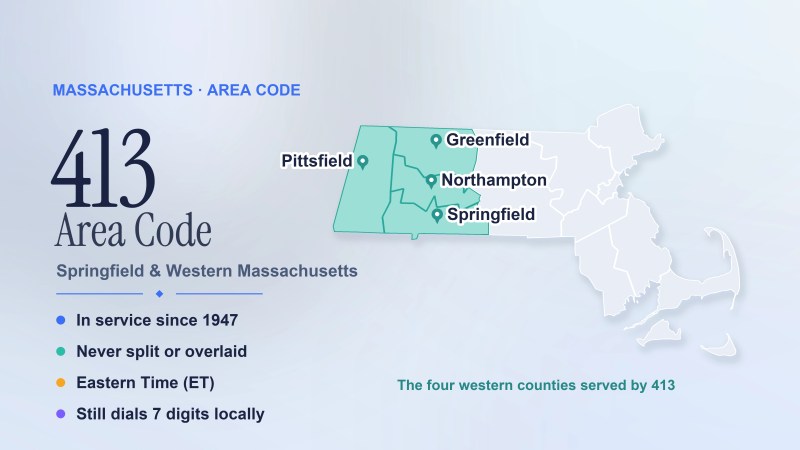
The 413 area code is more than a three-digit prefix—it’s a geographic and cultural anchor for Western Massachusetts, stitching together cities like Springfield, Northampton, and Pittsfield into a shared identity. Unlike the sprawling 201 or 617 codes, 413 carves out a distinct corner of New England, where rolling farmlands meet industrial heritage. Its boundaries, drawn in 1947, reflect a region that predates modern telecommunications, shaped by railroad routes and rural connectivity.
For locals, the 413 area code isn’t just functional; it’s a badge of belonging. Whether you’re dialing a number in the Berkshires or the Pioneer Valley, that prefix signals a place where history lingers—from the 19th-century textile mills of Holyoke to the counterculture roots of Northampton. Even today, businesses and residents leverage it as a marker of regional pride, a subtle nod to what sets this part of Massachusetts apart.
But how did 413 become the defining number for this stretch of land? The answer lies in the deliberate planning of the North American Numbering Plan (NANP), where geography, population density, and even political boundaries dictated the allocation of telephone codes. Unlike neighboring 413 is what area code regions, Western Massachusetts resisted fragmentation, preserving its numeric unity despite growth. This article traces the code’s evolution, its economic and social impact, and why it remains a quiet symbol of local identity.
###
The Complete Overview of 413 is What Area Code
The 413 area code serves as the primary telephone numbering designation for Western Massachusetts, encompassing a diverse landscape that stretches from the Connecticut River Valley to the Berkshire Mountains. It includes major cities such as Springfield (the region’s largest urban center), Northampton (a hub for education and arts), and Pittsfield (gateway to the Berkshires). Unlike neighboring codes like 508 (Cape Cod and the South Shore) or 978 (North Shore), 413 is what area code was designed to cover a contiguous swath of land where population density varies sharply—from the dense corridors of the Knowledge Corridor to the sparsely populated hills of Franklin County.What makes 413 distinctive is its longevity and stability. Unlike newer overlays or split codes, 413 has remained intact since its assignment in 1947, a rarity in an era where area codes frequently undergo reconfiguration due to exhaustion. This continuity reflects the region’s steady (if not explosive) growth, avoiding the need for splits seen in more populous areas. For businesses and residents, the code’s persistence also means fewer disruptions in communication infrastructure, a critical factor in a region where tourism, education, and healthcare rely on reliable connectivity.
###
Historical Background and Evolution
The origins of 413 is what area code trace back to the 1947 implementation of the NANP, a system that standardized telephone numbering across North America. At the time, Western Massachusetts was a patchwork of rural towns and industrial cities, with Springfield emerging as the dominant economic force. The allocation of 413 was part of a broader effort to rationalize telephone service, replacing the patchwork of exchange codes (like "Springfield 3") with a unified numbering system. The choice of 413 wasn’t arbitrary—it followed the NANP’s hierarchical structure, where the first digit (4) designated the New England region, and the subsequent digits (13) were assigned based on available blocks.Table of Contents
- The Complete Overview of 413 is What Area Code
- Historical Background and Evolution
- Core Mechanisms: How It Works
- Key Benefits and Crucial Impact
- Major Advantages
- Comparative Analysis
- Future Trends and Innovations
- Conclusion
- Comprehensive FAQs
- Q: Does the 413 area code cover any towns outside Massachusetts?
- Q: Why hasn’t the 413 area code been split like others?
- Q: Can businesses outside 413 use this area code for a local presence?
- Q: Are there any famous landmarks or events tied to the 413 area code?
- Q: What happens if the 413 area code runs out of numbers?
- Q: How does the 413 area code compare to other New England codes in terms of call volume?
- Q: Can I keep my 413 number if I move out of the area?
The code’s boundaries were drawn to align with existing geographic and administrative divisions. Hampshire and Hampden Counties, along with parts of Franklin and Berkshire Counties, fell under 413, creating a compact region that avoided the fragmentation seen in other states. This alignment was no accident; the NANP’s planners considered population density, existing infrastructure, and even political boundaries. For instance, the exclusion of Worcester County (which uses 508) reflects the historical divide between the industrialized west and the more agrarian east of the state. Over time, as suburbs expanded and rural areas saw slow growth, 413 remained a stable identifier, unlike neighboring 413 is what area code regions that required splits (e.g., 413’s neighbor 413 was never split, but nearby 203 in Connecticut was divided into 203/860).
###
Core Mechanisms: How It Works
At its core, the 413 area code operates under the same principles as all NANP-assigned codes: a three-digit prefix followed by a seven-digit local number, formatted as NXX-XXXX. The "413" prefix is part of the North American Numbering Plan Area (NANPA), which groups codes by region. Within 413, the next three digits (the "exchange code") further narrow the location, while the final four digits identify the specific line. For example, a number like 413-555-1234 might belong to a business in Springfield’s downtown core, whereas 413-233-5678 could serve a rural address in the Berkshires.The stability of 413 is what area code is partly due to its capacity management. Unlike codes like 212 (New York City) or 310 (Los Angeles), which have been exhausted and required overlays, 413 has not yet triggered a split. This is attributed to several factors: controlled urban sprawl, limited high-density commercial growth, and the region’s reliance on remote work and digital infrastructure. The Federal Communications Commission (FCC) monitors area code usage, and projections suggest that even with projected growth, 413 may not need an overlay for decades. For now, the code remains a reliable marker for callers and businesses alike.
###
Key Benefits and Crucial Impact
The 413 area code does more than facilitate calls—it shapes economic identity, tourism marketing, and even local pride. For businesses, especially small enterprises and nonprofits, the code serves as a trust signal. A customer seeing "413" on a bill or website instantly associates the number with Western Massachusetts, fostering a sense of authenticity. In a region where agriculture, manufacturing, and higher education are key industries, this local tie can be a competitive advantage. Similarly, real estate agents and chambers of commerce often highlight the 413 prefix as part of their branding, reinforcing the idea of a cohesive community.Beyond commerce, the area code plays a role in cultural narrative. Residents often reference it in conversations about home, much like how someone from Chicago might say "773" instead of "Illinois." This subtle but powerful association extends to sports teams, local media, and even political campaigns. For example, the Springfield Thunderbirds (a minor-league hockey team) and the Massachusetts Daily Collegian (UMass Amherst’s student newspaper) both use the 413 area code as part of their public identity, tying them to the region’s fabric.
"The 413 area code isn’t just a number—it’s a shorthand for where you’re from, what you value, and how you connect to the land. It’s the difference between dialing a stranger and calling home." — Local historian and telecom analyst, 2023
Major Advantages
The 413 area code offers several practical and symbolic advantages:- Regional Cohesion: Unlike fragmented codes, 413 unifies a geographically distinct area, making it easier for residents and businesses to identify with a shared numeric identity.
###

Comparative Analysis
While 413 is what area code stands out for its stability, other New England codes offer contrasting examples of growth and fragmentation. Below is a comparison of key area codes in the region:| Area Code | Key Characteristics |
|---|---|
| 413 | Western MA; no splits; covers Springfield, Northampton, Berkshires; low population density relative to urban centers. |
| 508 | Central/South MA; split into 508/774 (Worcester); high density in Cape Cod and Boston suburbs. |
| 617 | Boston metro; split into 617/857; highest call volume in New England. |
| 203 | Connecticut; split into 203/860; covers New Haven, Stamford, and rural areas. |
###
Future Trends and Innovations
Looking ahead, the 413 area code may face indirect pressures from digital transformation. As voice-over-IP (VoIP) services and virtual numbers grow in popularity, the traditional link between area codes and geography could weaken. However, for now, 413 remains a fixture in local life, with no immediate need for change. The region’s economic drivers—education (UMass, Smith College), healthcare (Baystate Medical Center), and tourism—are unlikely to strain the code’s capacity in the near term.That said, innovations like number pooling (where multiple area codes share the same geographic region) could eventually reshape how 413 is what area code functions. If implemented, this could allow for more flexible numbering while preserving local identity. For residents, the challenge will be balancing technological adaptation with the cultural significance of the code. One thing is certain: 413’s role as a symbol of Western Massachusetts will endure, even as the ways we use it evolve.
###

Conclusion
The 413 area code is far more than a telephone prefix—it’s a geographic and cultural cornerstone of Western Massachusetts. From its deliberate assignment in 1947 to its continued relevance today, the code reflects the region’s history, resilience, and sense of place. Whether you’re a longtime resident or a newcomer, recognizing 413 as your area code is a quiet affirmation of belonging.As telecommunications evolve, the question of whether 413 will remain unchanged or adapt to new systems will test the region’s priorities. For now, it stands as a testament to thoughtful planning and the enduring power of local identity in an increasingly connected world.
###
Comprehensive FAQs
Q: Does the 413 area code cover any towns outside Massachusetts?
A: No, the 413 area code is exclusively assigned to Western Massachusetts. It does not extend into Connecticut, Vermont, or any other state. The nearest neighboring codes (e.g., 860 in Connecticut) mark the boundary.
Q: Why hasn’t the 413 area code been split like others?
A: The 413 area code has avoided splits due to controlled population growth, limited high-density urban expansion, and efficient use of existing numbering blocks. Unlike Boston’s 617 or Worcester’s 508, Western Massachusetts hasn’t experienced the same level of call volume exhaustion.
Q: Can businesses outside 413 use this area code for a local presence?
A: Yes, some businesses (especially in e-commerce or remote work sectors) use 413 area codes via VoIP services to project a local Western Massachusetts identity, even if their operations are elsewhere. However, this practice is regulated to prevent fraud.
Q: Are there any famous landmarks or events tied to the 413 area code?
A: While the code itself isn’t tied to a single landmark, it’s closely associated with regional events like the Berkshire Music Festival (Pittsfield), Big E Fair (West Springfield), and Northampton’s River Valley Arts Festival. Locally, the code is often referenced in sports (e.g., Springfield Thunderbirds) and media.
Q: What happens if the 413 area code runs out of numbers?
A: If exhaustion occurs, the FCC would likely implement an overlay (adding a new code like 413/XXX) or number pooling to extend capacity. However, current projections suggest this won’t happen for decades, if at all.
Q: How does the 413 area code compare to other New England codes in terms of call volume?
A: The 413 area code handles significantly less call volume than urban codes like 617 (Boston) or 508 (Worcester/Cape Cod). Its lower density means fewer disruptions, but it also reflects a region with a mix of rural and mid-sized urban centers.
Q: Can I keep my 413 number if I move out of the area?
A: Generally, yes—if you port your number to a new carrier, you can retain the 413 prefix even when relocating. However, some VoIP providers may restrict geographic-based numbers for residential use.
Leave a Comment
Comments are moderated before appearing. The data you submit is processed according to the Privacy Policy of Medicine.